66 posters, 2 videos, 1 audios, 2 topics, 162 authors, 49 institutions
ePostersLive by SciGen Technologies S.A. All rights reserved.
American College of Prosthodontists - 2020 ANNUAL SESSION
November 4-7 | Virtual Meeting
58
Reducing Macroglossia to Fabricate a Functional Prosthesis
Poster Presenter
Authors
Mary Machowski , Henry Ferguson , Jimmy Londono , Darshanjit Pannu
Affiliations
Part of Topic
Case Presentation
Reducing Macroglossia to Fabricate a Functional Prosthesis
M. Machowski, DMD, H. Ferguson DMD1, J. Londono DDS, D. Pannu DDS
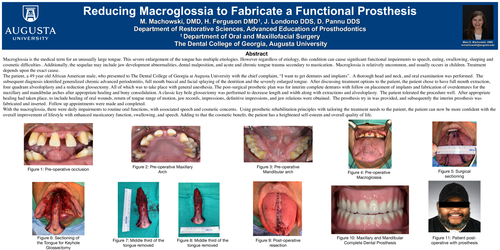
Macroglossia is the medical term for an unusually large tongue. This severe enlargement of the tongue has multiple etiologies. However regardless of etiology, this condition can cause significant functional impairments to speech, eating, swallowing, sleeping and cosmetic difficulties . Additionally, the sequelae may include jaw development abnormalities, dental malposition, and acute and chronic tongue trauma secondary to mastication. Macroglossia is relatively uncommon, and usually occurs in children. Treatment depends upon the exact cause.
The patient, a 49 year old African American male, who presented to The Dental College of Georgia at Augusta University with the chief complaint, “I want to get dentures and implants”. A thorough head and neck, and oral examination was performed. The subsequent diagnosis identified generalized chronic advanced periodontitis, full mouth buccal and facial splaying of the dentition and the severely enlarged tongue. After discussing treatment options to the patient, the patient chose to have full mouth extraction, four quadrant alveoloplasty and a reduction glossectomy. All of which was to take place with general anesthesia. The post-surgical prosthetic plan was for interim complete dentures with follow on placement of implants and fabrication of overdentures for the maxillary and mandibular arches after appropriate healing and bony consolidation. A classic key hole glossectomy was performed to decrease length and width along with extractions and alveoloplasty. The patient tolerated the procedure well. After appropriate healing had taken place, to include healing of oral wounds, return of tongue range of motion, jaw records, impressions, definitive impressions, and jaw relations were obtained. The prosthesis try in was provided, and subsequently the interim prosthesis was fabricated and inserted. Follow up appointments were made and completed.
With the macroglossia, there were daily impairments to routine oral functions, with associated speech and cosmetic concerns. Using prosthetic rehabilitation principles with tailoring the treatment needs to the patient, the patient can now be more confident with the overall improvement of lifestyle with enhanced masticatory function, swallowing, and speech. Adding to that the cosmetic benefit, the patient has a heightened self-esteem and overall quality of life.