66 posters, 2 videos, 1 audios, 2 topics, 162 authors, 49 institutions
ePostersLive by SciGen Technologies S.A. All rights reserved.
American College of Prosthodontists - 2020 ANNUAL SESSION
November 4-7 | Virtual Meeting
53
Esthetic and functional rehabilitation of a Skeletal class II with pathologic tooth migration: an interdisciplinary approach
Poster Presenter
Authors
Affiliations
Part of Topic
Case Presentation
Esthetic and Functional Rehabilitation of a Skeletal Class II with Pathologic Tooth Migration: An Interdisciplinary Approach
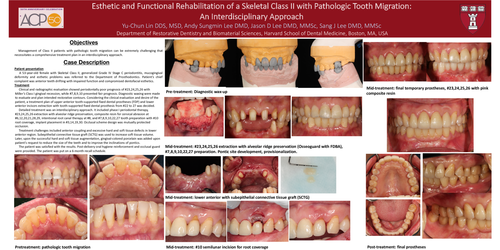
Objectives: Management of Class II patients with pathologic tooth migration can be extremely challenging that necessitates a comprehensive treatment plan in an interdisciplinary approach.
Case description:
Patient presentation
A 53-year-old female with Skeletal Class II, generalized Grade IV Stage C periodontitis, mucogingival deformity and esthetic problems was referred to the Department of Prosthodontics. Patient’s chief complaint was anterior teeth drifting with impaired function and compromised dentofacial esthetics.
Treatment
Clinical and radiographic evaluation showed periodontally poor prognosis of #23,24,25,26 with Miller’s Class I gingival recession, while #7,8,9,10 presented fair prognosis. Diagnostic waxing were made to evaluate and plan intended restorative contours. Considering the clinical evaluation and desire of the patient, a treatment plan of upper anterior tooth-supported fixed dental prostheses (FDP) and lower anterior incisors extraction with tooth-supported fixed dental prosthesis from #22 to 27 was decided.
Detailed treatment was an interdisciplinary approach. It included phase I periodontal therapy, #23,24,25,26 extraction with alveolar ridge preservation, composite resin for cervical abrasion at #6,12,20,21,28,29, intentional root canal therapy at #8, and #7,8,9,10,22,27 tooth preparation with #10 root coverage, implant placement in #3,14,19,30. Occlusal scheme design was mutually protected occlusion.
Treatment challenges included anterior coupling and excessive hard and soft tissue defects in lower anterior region. Subepithelial connective tissue graft (SCTG) was used to increase soft tissue volume. Later, upon the successful hard and soft tissue augmentation, gingival-colored porcelain was added upon patient’s request to reduce the size of the teeth and to improve the inclinations of pontics.
The patient was satisfied with the results. Post-delivery oral hygiene reinforcement and occlusal guard were provided. The patient was put on a 6-month recall schedule.