66 posters, 2 videos, 1 audios, 2 topics, 162 authors, 49 institutions
ePostersLive by SciGen Technologies S.A. All rights reserved.
American College of Prosthodontists - 2020 ANNUAL SESSION
November 4-7 | Virtual Meeting

44
<p>Digital Work Flow of Printed Immediate Interim Removable Partial Denture Prosthesis - A Case Report </p> <p> </p>
Poster Presenter
Part of Topic
Case Presentation
Digital Work Flow of Printed Immediate Interim Removable Partial Denture Prostheses: A Case Report
Arpita Patel DDS, Paul Zhivago DDS, FACP, Thomas Giugliano DDS, Mijin Choi DDS, MS, MBA, FACP
Jonathan and Maxine Ferencz Advanced Education Program in Prosthodontics New York University College of Dentistry
Introduction
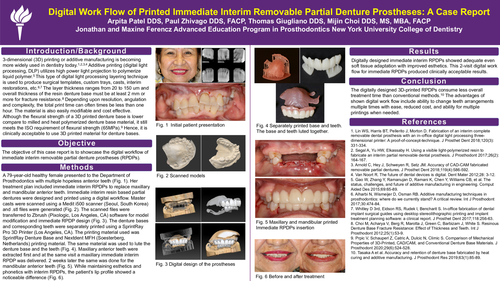
3-dimensional (3D) printing or additive manufacturing is becoming more widely used in dentistry today.1,2,3,4 Additive printing (digital light processing, DLP) utilizes high power light projection to polymerize liquid polymer.5 This type of digital light processing layering technique is used to produce surgical templates, custom trays, casts, interim restorations, etc.6,7 The layer thickness ranges from 20 to 150 um and overall thickness of the resin denture base must be at least 2 mm or more for fracture resistance.8 Depending upon resolution, angulation and complexity, the total print time can often times be less than one hour. The material is also easily modifiable and cost effective. Although the flexural strength of a 3D printed denture base is lower compare to milled and heat polymerized denture base material, it still meets the ISO requirement of flexural strength (65MPa).9 Hence, it is clinically acceptable to use 3D printed material for denture bases.
Objective
The objective of this case report is to showcase the digital workflow of immediate interim removable partial denture prostheses (RPDPs).
Methods
A 79-year-old healthy female presented to the Department of Prosthodontics with multiple hopeless anterior teeth (Fig. 1). Her treatment plan included immediate interim RPDPs to replace maxillary and mandibular anterior teeth. Immediate interim resin based partial dentures were designed and printed using a digital workflow. Master casts were scanned using a Medit i500 scanner (Seoul, South Korea) and .stl files were generated (Fig. 2). The scanned files were transferred to Zbrush (Pixologic, Los Angeles, CA) software for model modification and immediate RPDP design (Fig. 3). The denture bases and corresponding teeth were separately printed using a SprintRay Pro 3D Printer (Los Angeles, CA). The printing material used was SprintRay Denture Base and Nextdent MFH (Soesterberg, Netherlands) printing material. The same material was used to lute the denture base and the teeth (Fig. 4). Maxillary anterior teeth were extracted first and at the same visit a maxillary immediate interim RPDP was delivered. 2 weeks later the same was done for the mandibular anterior teeth (Fig. 5). While maintaining esthetics and phonetics with interim RPDPs, the patient’s lip profile showed a noticeable difference (Fig. 6).
Results
Digitally designed immediate interim RPDPs showed adequate even soft tissue adaptation with improved esthetics. This 2-visit digital work flow for immediate RPDPs produced clinically acceptable results.
Conclusion
The digitally designed 3D-printed RPDPs consume less overall treatment time than conventional methods.10 The advantages of shown digital work flow include ability to change teeth arrangements multiple times with ease, reduced cost, and ability for multiple printings when needed.
References