66 posters, 2 videos, 1 audios, 2 topics, 162 authors, 49 institutions
ePostersLive by SciGen Technologies S.A. All rights reserved.
American College of Prosthodontists - 2020 ANNUAL SESSION
November 4-7 | Virtual Meeting

42
Implant rehabilitation planning for edentulous maxilla according to lip support and restorative space: a case report.
Poster Presenter
Authors
Affiliations
Part of Topic
Case Presentation
Video
Audio
Implant rehabilitation planning for the edentulous maxilla according to lip support and restorative
space: a patient study
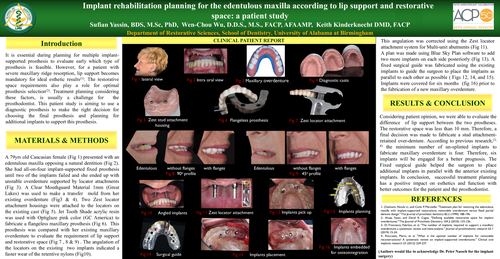
It is essential during planning for multiple implant-supported prosthesis to evaluate early which type of prosthesis is feasible. However, for a patient with severe maxillary ridge resorption, lip support becomes mandatory for ideal esthetic results(1). The restorative space requirements also play a role for optimal prosthesis selection(2). Treatment planning considering these factors, is usually a challenge for the prosthodontist. This patient study is aiming to use a diagnostic prosthesis to make the right decision for choosing the final prosthesis and planning for additional implants to support this prosthesis.
A 79yrs old Caucasian female (Fig 1) presented with an edentulous maxilla opposing a natural dentition (Fig 2). She had all-on-four implant-supported fixed prosthesis until two of the implants failed and she ended up with unstable overdenture supported by locator attachments (Fig 3). A Clear Mouthguard Material 1mm (Great Lakes) was used to make a transfer mold from her existing overdenture (Fig3 & 4). Two Zest locator attachment housings were attached to the locators on the existing cast (Fig 5). Jet Tooth Shade acrylic resin was used with Optiglaze pink color (GC America) to fabricate a flangeless maxillary prosthesis (Fig 6). This prosthesis was compared with her existing maxillary overdenture to evaluate the requirement of lip support and restorative space (Fig 7 , 8 & 9) . The angulation of the locators on the existing two implants indicated a faster wear of the retentive nylons (Fig10).
This angulation was corrected using the Zest locator attachment system for Multi-unit abutments (Fig 11).
A plan was made using Blue Sky Plan software to add two more implants on each side posteriorly (Fig 13). A fixed surgical guide was fabricated using the existing implants to guide the surgeon to place the implants as parallel to each other as possible ( Figs 12, 14, and 15). Implants were covered for six months (fig 16) prior to the fabrication of a new maxillary overdenture.
Considering patient opinion, we were able to evaluate the difference of lip support between the two prostheses. The restorative space was less than 10 mm. Therefore, a final decision was made to fabricate a stud attachment-retained over-denture. According to previous research,(3, 4) the minimum number of un-splinted implants to fabricate maxillary overdenture is four. Therefore, six implants will be engaged for a better prognosis. The Fixed surgical guide helped the surgeon to place additional implants in parallel with the anterior existing implants. In conclusion, successful treatment planning has a positive impact on esthetics and function with better outcomes for the patient and the prosthodontist.