66 posters, 2 videos, 1 audios, 2 topics, 162 authors, 49 institutions
ePostersLive by SciGen Technologies S.A. All rights reserved.
American College of Prosthodontists - 2020 ANNUAL SESSION
November 4-7 | Virtual Meeting
33
The use of three quarters restoration for FDP as an alternate method for long-term provisional in a growing teenager. A clinical case presentation.
Poster Presenter
Authors
Affiliations
Part of Topic
Case Presentation
The use of three quarters FDP retainer as an alternate method for long -term provisional in a growing teenager :A clinical case presentation
Authors : Youssef M Kassem , Jorge Palavicini , Edwin Kee
Department of prosthodontics
Louisiana State University School of Dentistry, New Orleans, LA
introduction
Traumatic loss of anterior teeth is a common problem in growing children. The fabrication of a definitive prosthesis should be delayed until facial growth is stable.
A common treatment option for these situations are removable prosthesis in the form of Essex retainers or acrylic RPD’s. These prostheses can create negative psychological and biological effects on a patient.
The purpose of this case report is to present a simple and inexpensive long-term provisional option for children or adolescent patients who have lost one or more anterior teeth until they reach a suitable age for definitive treatment.
Procedure
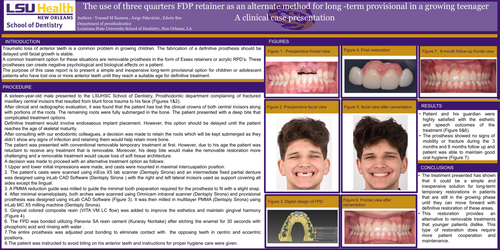
A sixteen-year-old male presented to the LSUHSC School of Dentistry, Prosthodontic department complaining of fractured maxillary central incisors that resulted from blunt force trauma to his face (Figures 1&2).
After clinical and radiographic evaluation, it was found that the patient has lost the clinical crowns of both central incisors along with portions of the roots. The remaining roots were fully submerged in the bone. The patient presented with a deep bite that complicated treatment options.
Definitive treatment would involve endosseous implant placement. However, this option should be delayed until the patient reaches the age of skeletal maturity.
After consulting with our endodontic colleagues, a decision was made to retain the roots which will be kept submerged as they didn’t show any signs of infection and retaining them would help retain more bone.
The patient was presented with conventional removable temporary treatment at first. However, due to his age the patient was reluctant to receive any treatment that is removable. Moreover, his deep bite would make the removable restoration more challenging and a removable treatment would cause loss of soft tissue architecture.
A decision was made to proceed with an alternative treatment option as follows:
1.Upper and lower initial impressions were made, and casts were mounted in maximal intercuspation position.
2. The patient’s casts were scanned using inEos X5 lab scanner (Dentsply Sirona) and an intermediate fixed partial denture was designed using inLab CAD Software (Dentsply Sirona ) with the right and left lateral incisors used as support covering all sides except the lingual.
3. A PMMA reduction guide was milled to guide the minimal tooth preparation required for the prosthesis to fit with a slight snap.
4. After minimal enameloplasty, both arches were scanned using Omnicam intraoral scanner (Dentsply Sirona) and provisional prosthesis was designed using inLab CAD Software (Figure 3). It was then milled in multilayer PMMA (Dentsply Sirona) using inLab MC X5 milling machine (Dentsply Sirona).
5. Gingival colored composite resin (VITA VM LC flow) was added to improve the esthetics and maintain gingival harmony (Figure 4).
6. The FPD was bonded utilizing Panavia SA resin cement (Kuraray Noritake) after etching the enamel for 30 seconds with phosphoric acid and rinsing with water .
7.The entire prosthesis was adjusted post bonding to eliminate contact with the opposing teeth in centric and eccentric positions.
8.The patient was instructed to avoid biting on his anterior teeth and instructions for proper hygiene care were given
results
conclusions