66 posters, 2 videos, 1 audios, 2 topics, 162 authors, 49 institutions
ePostersLive by SciGen Technologies S.A. All rights reserved.
American College of Prosthodontists - 2020 ANNUAL SESSION
November 4-7 | Virtual Meeting
29
Tissue Displacement Techniques for Optimum Final Impression of Fixed Restorations
Poster Presenter
Part of Topic
Case Presentation
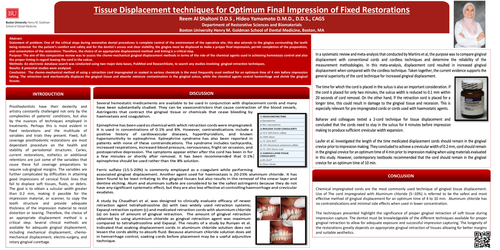
Tissue Displacement techniques for Optimum Final Impression of Fixed Restorations
Statement of problem: One of the critical steps during restorative dental procedures is complete control of the environment of the operative site, this also extends to the gingiva surrounding the teeth being restored. For the patient’s comfort and safety and for the dentist's access and clear visibility, the gingiva must be displaced to make a proper final impression, permit completion of the preparation, and cementation of the restoration. Therefore, the choice of an appropriate displacement method and timing is a critical step.
Purpose: The aim of this comparative review was to assess the chemo-mechanical gingival displacement methods in terms of the role of the chemical agents used in achieving hemostasis control and also the proper timing in regard leaving the cord in the sulcus.
Methods: An electronic database search was conducted using two major data bases, PubMed and ResearchGate, to search any studies involving gingival retraction techniques.
Results: 8 potential studies were analysed.
Conclusion: The chemo-mechanical method of using a retraction cord impregnated or soaked in various chemicals is the most frequently used method for an optimum time of 4 min before impression taking. The retraction cord mechanically displaces the gingival tissue and absorbs moisture contamination in the gingival sulcus, while the chemical agents control hemorrhage and shrink the gingival tissues.