241 posters, 10 topics, 7 sessions, 899 authors, 296 institutions
ePostersLive by SciGen Technologies S.A. All rights reserved.
The AAPS 103rd Annual Meeting 2025
May 24-27, 2025 | Austin, Texas

D7
Impact Of Autoimmune Connective Tissue Diseases On Breast Reduction Complication Rates
Poster Presenter
Part of Topic
Aesthetic Breast/Body Contouring
Impact of Autoimmune Connective Tissue Diseases on Breast Reduction Complication Rates
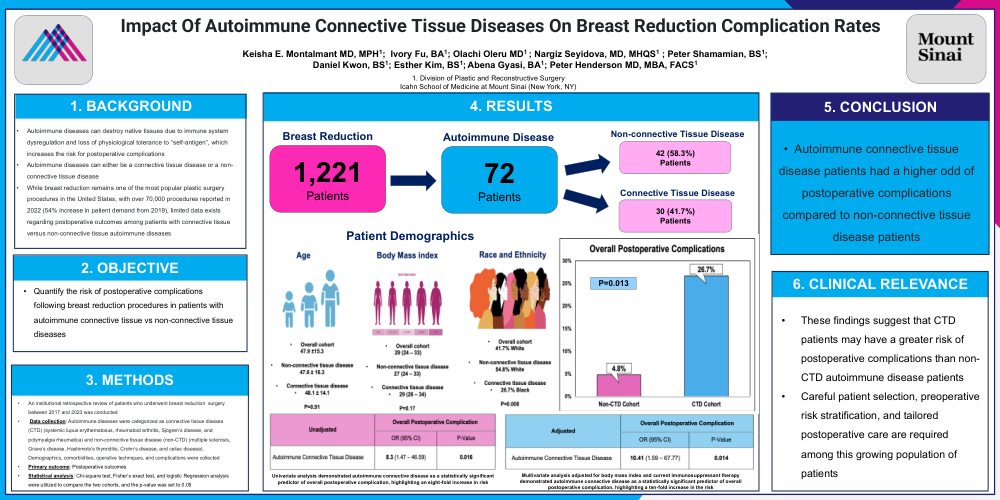
Background: Autoimmune diseases can destroy native tissues due to immune system dysregulation and loss of physiological tolerance to “self-antigen”, which increases the risk for postoperative complications. Autoimmune diseases can either be a connective tissue disease or a non-connective tissue disease. While breast reduction remains one of the most popular plastic surgery procedures in the United States, with over 70,000 procedures reported in 2022 (54% increase in patient demand from 2019), limited data exists regarding postoperative outcomes among patients with connective tissue versus non-connective tissue autoimmune diseases.
Objective: Quantify the risk of postoperative complications following breast reduction procedures in patients with autoimmune connective tissue vs non-connective tissue diseases.
Methods: An institutional retrospective review of patients who underwent breast reduction surgery between 2017 and 2023 was conducted. Autoimmune diseases were categorized as connective tissue disease (CTD) (systemic lupus erythematosus, rheumatoid arthritis, Sjogren’s disease, and polymyalgia rheumatica) and non-connective tissue disease (non-CTD) (multiple sclerosis, Grave’s disease, Hashimoto’s thyroiditis, Crohn’s disease, and celiac disease). Demographics, comorbidities, operative techniques, and complications were collected. Chi-square test, Fisher’s exact test, and logistic Regression analysis were utilized to compare the two cohorts, and the p-value was set to 0.05.
Results: A total of 72 patients (126 breasts) with non-CTD (58.8%) or CTD (41%) were identified. The mean age was 47.9 ±15.3 years. Fifty-four patients (75%) underwent bilateral BR, and eighteen (25%) underwent unilateral BR. The superomedial pedicle (45.8%) and inferior pedicle technique (44.4%) were primarily used. The complication rate for all BR procedures in the database was 15%. Complications occurred in 26% of CTD patients: fat necrosis (13.3%), infection (13.3%), seroma (10%), T-junction breakdown (6.6%), and wound dehiscence (3.3%). One non-CTD patient required revision. The average intraoperative blood loss was 70 ± 76.8 mL in CTD patients and 61.8 ± 62.1 mL in non-CTD patients. The mean length of operation was 3.04 ± 1.17 hours in CTD patients and 2.6 ± 1.29 hours in non-CTD patients.
Conclusions: Autoimmune CTD patients had a relatively high rate of postoperative complications with increased intraoperative blood loss and operative time. These findings suggest that CTD patients may have a greater risk of complications and highlight the importance of careful patient selection, preoperative risk stratification, and tailored postoperative care in AD patients.