241 posters, 10 topics, 7 sessions, 899 authors, 296 institutions
ePostersLive by SciGen Technologies S.A. All rights reserved.
The AAPS 103rd Annual Meeting 2025
May 24-27, 2025 | Austin, Texas

D1
Application Of Helium Plasma To Improve The Stretch Marks: Histological Evaluation And Long-term Patient Satisfaction
Poster Presenter
Authors
Affiliations
Part of Topic
Aesthetic Breast/Body Contouring
title: Application Of Helium Plasma To Improve The Stretch Marks: Histological Evaluation And Long-termPatientSatisfaction
Authors: Paolo Persichetti, MD PhD, FEBOPRAS Professor and Chairman and Mauro Barone, MD PhD
Introduction: The purpose of this study was to demonstrate that the use of Renuvion can reduce stretch marks and improve skin quality
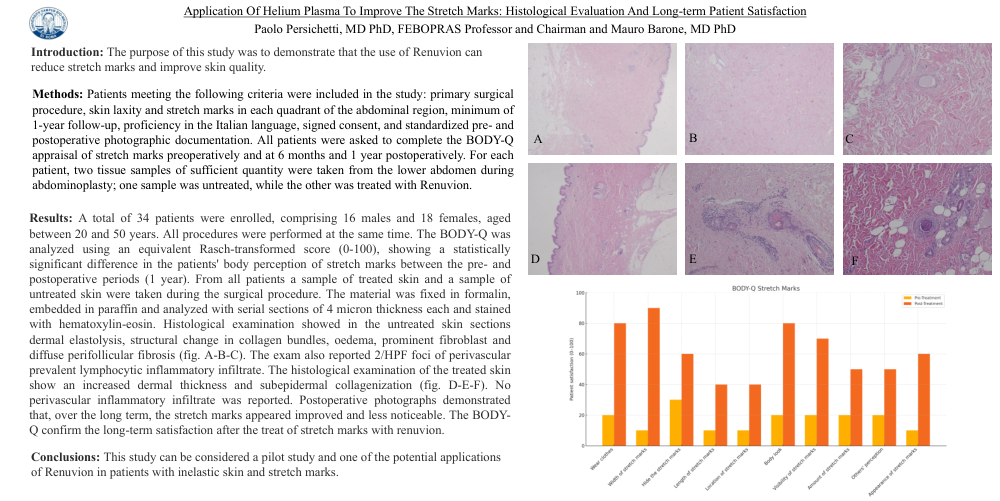
Methods: Patients meeting the following criteria were included in the study: primary surgical procedure, skin laxity and stretch marks in each quadrant of the abdominal region, minimum of 1-year follow-up, proficiency in the Italian language, signed consent, and standardized pre- and postoperative photographic documentation. All patients were asked to complete the BODY-Q appraisal of stretch marks preoperatively and at 6 months and 1 year postoperatively. For each patient, two tissue samples of sufficient quantity were taken from the lower abdomen during abdominoplasty; one sample was untreated, while the other was treated with Renuvion.
Results: A total of 34 patients were enrolled, comprising 16 males and 18 females, aged between 20 and 50 years. All procedures were performed at the same time. The BODY-Q was analyzed using an equivalent Rasch-transformed score (0-100), showing a statistically significant difference in the patients' body perception of stretch marks between the pre- and postoperative periods (1 year). From all patients a sample of treated skin and a sample of untreated skin were taken during the surgical procedure. The material was fixed in formalin, embedded in paraffin and analyzed with serial sections of 4 micron thickness each and stained with hematoxylin-eosin. Histological examination showed in the untreated skin sections dermal elastolysis, structural change in collagen bundles, oedema, prominent fibroblast and diffuse perifollicular fibrosis (fig. A-B-C). The exam also reported 2/HPF foci of perivascular prevalent lymphocytic inflammatory infiltrate. The histological examination of the treated skin show an increased dermal thickness and subepidermal collagenization (fig. D-E-F). No perivascular inflammatory infiltrate was reported. Postoperative photographs demonstrated that, over the long term, the stretch marks appeared improved and less noticeable. The BODY-Q confirm the long-term satisfaction after the treat of stretch marks with renuvion.
Conclusions: This study can be considered a pilot study and one of the potential applications of Renuvion in patients with inelastic skin and stretch marks.