241 posters, 10 topics, 7 sessions, 899 authors, 296 institutions
ePostersLive by SciGen Technologies S.A. All rights reserved.
The AAPS 103rd Annual Meeting 2025
May 24-27, 2025 | Austin, Texas

D10
Systematic Review Of Excisional Techniques For The Correction Of Gynecomastia
Poster Presenter
Part of Topic
Aesthetic Breast/Body Contouring
Title: Systematic Review of Excisional Techniques for the Treatment of Gynecomastia
Intro: The aim of this study is to evaluate outcomes of excisional techniques for surgical correction of gynecomastia.
Methods: A comprehensive literature search was conducted in PubMed/Medline, SCOPUS, and the Cochrane database of controlled trials for studies evaluating outcomes in gynecomastia surgery. The Preferred Reporting Items in Systematic Reviews and Meta-Analyses (PRISMA) were applied. Included studies were any mastectomy technique for gynecomastia and primary literature. Liposuction-only cases were excluded.
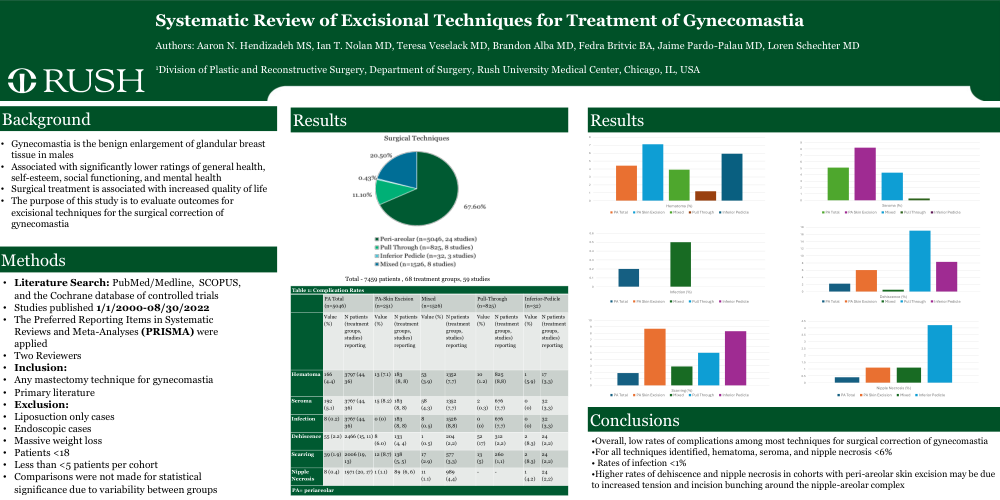
Results: 7459 patients in 68 treatment groups from 59 studies were included. Surgical techniques included periareolar (67.6 %, n=5046, 24 studies), inferior pedicle (0.43%, n=32, 3 studies), pull-through (11.1%, n=825, 8 studies), and mixed (20.5%, n=1526, 8 studies) techniques.
Outcomes for each cohort are found in Table 1. For all techniques identified, rates of hematoma, seroma, and nipple necrosis were less than 6%, and rates of infection were less than 1%. High rates of dehiscence (17%) were identified in the pull-through cohort.
A subset of the periareolar patients (n=251, 10 studies) had periareolar skin excision in a Bunnelli-type or similar incision. This group demonstrated higher rates of dehiscence (6.02%), scarring (8.70%) and nipple necrosis (1.12%).
Conclusions: Most techniques for gynecomastia demonstrate low complications rates. Higher rates of dehiscence and nipple necrosis in cohorts with periareolar skin excision may be due to increased tension and incision bunching around the nipple-areolar complex.