Loading...

241 posters, 10 topics, 7 sessions, 899 authors, 296 institutions

ePostersLive by SciGen Technologies S.A. All rights reserved.

The AAPS 103rd Annual Meeting 2025

May 24-27, 2025 | Austin, Texas

The AAPS 103rd Annual Meeting 2025 banner

D2

Assessing The Efficacy Of Mesh In Cosmetic Breast Procedures: A Comprehensive Review Of Complications And Cosmetic Outcomes
Part of Topic

Aesthetic Breast/Body Contouring

ASSESSING THE EFFICACY OF MESH IN COSMETIC BREAST PROCEDURES: 
A COMPREHENSIVE REVIEW OF COMPLICATIONS AND COSMETIC OUTCOMES

Sonya Williams, BS,1 Orr Shauly, MD,2 Ambika Menon, MD,2 Eliana Jolkovsky, BA,3 James Sherrer, BS,1 Daniel J. Gould, MD, PhD,4Albert Losken, MD2

1. Emory School of Medicine, Atlanta, Georgia
2. Emory Division of Plastic and Reconstructive Surgery, Atlanta, Georgia
3. University of California Los Angeles David Geffen School of Medicine, Los Angeles, CA
4. Private Practice, Beverly Hills, CA
 
Background: The insertion of a synthetic or biologic mesh “internal bra” has been used in cosmetic breast procedures for soft tissue reinforcement as a means to mitigate postoperative ptosis. However, there have been concerns regarding risk of complications as a result of mesh placement and a lack of quantitative data regarding postoperative cosmetic outcomes. 

Methods: Manuscripts that provided data with respect to the effects of mesh “internal bra” for soft tissue support on quantitative and qualitative cosmetic outcomes, patient reported outcomes, complications, and surveillance were reviewed. Meta-analysis was performed to determine the overall complication rates and cosmetic outcomes and patient reported outcomes were reviewed.  
 
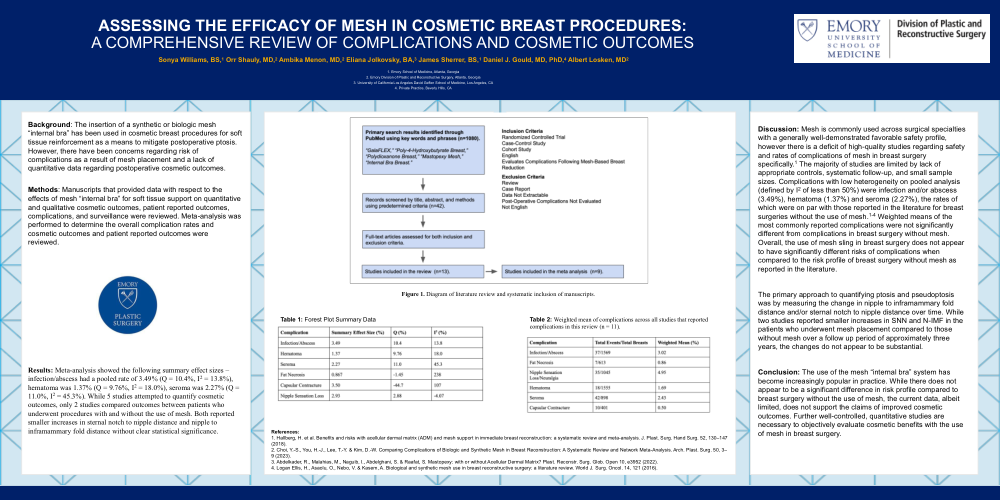
Results: Meta-analysis showed the following summary effect sizes – infection/abscess had a pooled rate of 3.49% (Q = 10.4%, I2 = 13.8%), hematoma was 1.37% (Q = 9.76%, I2 = 18.0%), seroma was 2.27% (Q = 11.0%, I2 = 45.3%). While 5 studies attempted to quantify cosmetic outcomes, only 2 studies compared outcomes between patients who underwent procedures with and without the use of mesh. Both reported smaller increases in sternal notch to nipple distance and nipple to inframammary fold distance without clear statistical significance. 
 
Discussion: Mesh is commonly used across surgical specialties with a generally well-demonstrated favorable safety profile, however there is a deficit of high-quality studies regarding safety and rates of complications of mesh in breast surgery specifically.1 The majority of studies are limited by lack of appropriate controls, systematic follow-up, and small sample sizes. Complications with low heterogeneity on pooled analysis (defined by I2 of less than 50%) were infection and/or abscess (3.49%), hematoma (1.37%) and seroma (2.27%), the rates of which were on par with those reported in the literature for breast surgeries without the use of mesh.1-4 Weighted means of the most commonly reported complications were not significantly different from complications in breast surgery without mesh. Overall, the use of mesh sling in breast surgery does not appear to have significantly different risks of complications when compared to the risk profile of breast surgery without mesh as reported in the literature.
 
The primary approach to quantifying ptosis and pseudoptosis was by measuring the change in nipple to inframammary fold distance and/or sternal notch to nipple distance over time. While two studies reported smaller increases in SNN and N-IMF in the patients who underwent mesh placement compared to those without mesh over a follow up period of approximately three years, the changes do not appear to be substantial. 
 
Conclusion: The use of the mesh “internal bra” system has become increasingly popular in practice. While there does not appear to be a significant difference in risk profile compared to breast surgery without the use of mesh, the current data, albeit limited, does not support the claims of improved cosmetic outcomes. Further well-controlled, quantitative studies are necessary to objectively evaluate cosmetic benefits with the use of mesh in breast surgery. 
 

References: 

1. Hallberg, H. et al. Benefits and risks with acellular dermal matrix (ADM) and mesh support in immediate breast reconstruction: a systematic review and meta-analysis. J. Plast. Surg. Hand Surg. 52, 130–147 (2018).

2. Choi, Y.-S., You, H.-J., Lee, T.-Y. & Kim, D.-W. Comparing Complications of Biologic and Synthetic Mesh in Breast Reconstruction: A Systematic Review and Network Meta-Analysis. Arch. Plast. Surg. 50, 3–9 (2023).

3. Abdelkader, R., Malahias, M., Naguib, I., Abdelghani, S. & Raafat, S. Mastopexy: with or without Acellular Dermal Matrix? Plast. Reconstr. Surg. Glob. Open 10, e3952 (2022).

4. Logan Ellis, H., Asaolu, O., Nebo, V. & Kasem, A. Biological and synthetic mesh use in breast reconstructive surgery: a literature review. World J. Surg. Oncol. 14, 121 (2016).


aaps2025 banner
Copyright © 2015-2026, ePostersLive® SciGen is a registered trademark of SciGen Technologies S.A. Patent pending.

This website and third-party tools we use rely on cookies for the best user experience. By selecting "I agree", you agree to cookie usage as described in our Privacy Policy.