241 posters, 10 topics, 7 sessions, 899 authors, 296 institutions
ePostersLive by SciGen Technologies S.A. All rights reserved.
The AAPS 103rd Annual Meeting 2025
May 24-27, 2025 | Austin, Texas

D4
Development Of A Domain-specific Large Language Model For Aesthetic Surgery Using Gpt-2: A Proof-of-concept Study
Poster Presenter
Authors
Affiliations
Cleveland Clinic, Cleveland Clinic Department of Plastic Surgery
Part of Topic
Aesthetic Breast/Body Contouring
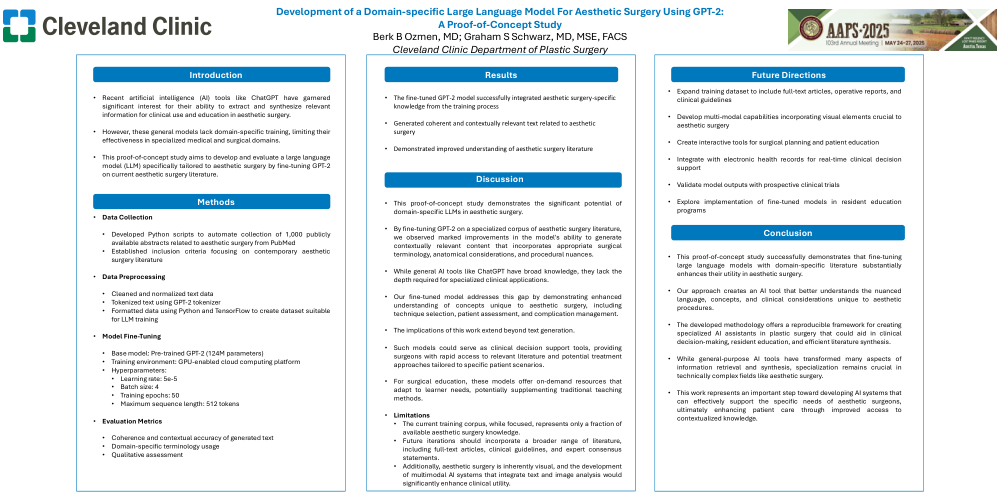
PURPOSE: Recent artificial intelligence (AI) tools like ChatGPT have garnered significant interest for their ability to extract and synthesize relevant information for clinical use and education in aesthetic surgery. However, these general models lack domain-specific training, limiting their effectiveness in specialized medical fields. This proof-of-concept study aims to develop and evaluate a large language model (LLM) specifically tailored to aesthetic surgery by fine-tuning GPT-2 on current aesthetic surgery literature.
METHODS: We developed Python scripts to automate the collection of 1,000 publicly available abstracts related to aesthetic surgery from PubMed. The abstracts were preprocessed, tokenized, and formatted using Python and TensorFlow to create a dataset suitable for LLM training. We fine-tuned the pre-trained GPT-2 model on this dataset in a GPU-enabled environment, adjusting its parameters to better align with aesthetic surgery literature. The model's performance was evaluated based on its ability to generate coherent and contextually accurate text related to aesthetic surgery when prompted.
RESULTS: The fine-tuned GPT-2 model successfully integrated aesthetic surgery-specific knowledge from the training process. It efficiently generated coherent and contextually relevant text related to aesthetic surgery, demonstrating promising proficiency in the domain.
CONCLUSION: This proof-of-concept study highlights the potential of fine-tuning large language models like GPT-2 with domain-specific literature to enhance their applicability in aesthetic surgery. The developed Python code offers innovative applications of AI in this field. Future work can focus on expanding the training dataset, improving the model's ability to generate coherent hypotheses, summarizing literature, and explaining complex concepts in aesthetic surgery.