241 posters, 10 topics, 7 sessions, 899 authors, 296 institutions
ePostersLive by SciGen Technologies S.A. All rights reserved.
The AAPS 103rd Annual Meeting 2025
May 24-27, 2025 | Austin, Texas

P4
Abdominoplasty Practice Patterns: An American Society Of Plastic Surgeons (ASPS) Member Survey - How Much Has Changed Over 20 Years?
Part of Topic
Aesthetic Breast/Body Contouring
Abdominoplasty Practice Patterns: An American Society of Plastic Surgeons (ASPS) Member Survey - How Much Has Changed Over 20 Years?
Morgan L. Fish, M.D.,1* Marjorie C. Kragel, M.D.,1* Elad T. Fraiman, B.A., M.P.H.,2 Pierce L. Janssen, M.D.,1 Osama Darras, M.D., PhD(c),1 Alan Matarasso, M.D.,3 James E. Zins, M.D., F.A.C.S.1
BACKGROUND
In 2006, Matarasso et al. published a detailed report on aesthetic abdominal wall contouring procedures as practiced by members of the American Society of Plastic Surgeons. The 2006 survey evaluated aesthetic abdominal contouring practice patterns including indications, techniques, ancillary procedures, and complications. Ongoing debate about preferred techniques continues to this day. Drain use, compression use, venous thromboembolism (VTE) prophylaxis, and abdominoplasty flap liposuction are just a few of the many factors that have consistently varied between plastic surgeons. Newer tools such as progressive tension sutures (PTS) and tranexamic acid (TXA) have also been popularized since 2006. However, no study has objectively analyzed these changes in the ensuing decades of practice.
OBJECTIVES
The purpose of this study is to examine recent trends in abdominoplasty practices since the previous survey and highlight changes in surgical techniques and practice patterns. We will compare this information to the latest recommendations in plastic surgery literature.
METHODS
A 38 question survey was designed based on the 2006 survey. Additional questions of interest were added to account for surgical advances over the past two decades. Survey questions focused mainly on operative technique and surgical adjuncts for full abdominoplasty. The survey instrument was electronically distributed three times in 2023 to a random cohort of 1,765 ASPS members. Chi-Square and Fisher's Exact Test were used to compare proportions as appropriate.
RESULTS
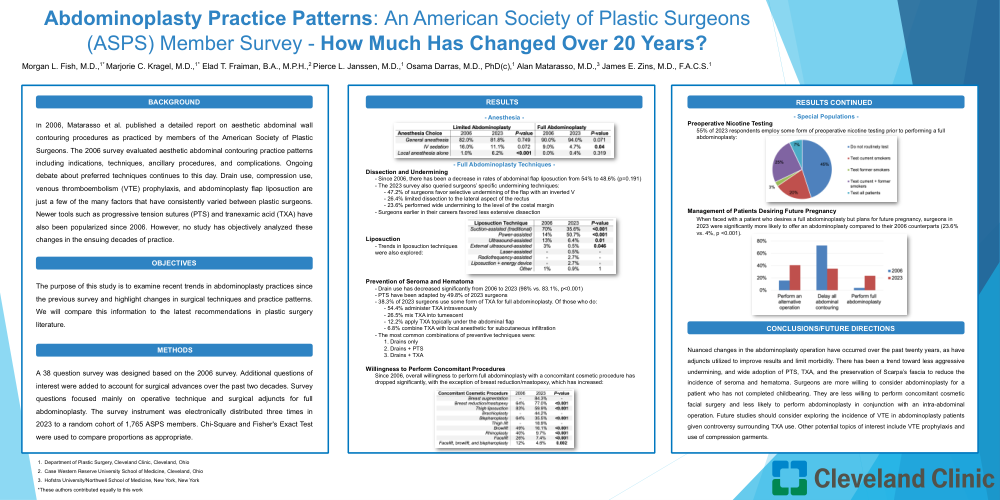
Anesthesia
[table]
Dissection and Undermining
- Since 2006, there has been a decrease in rates of abdominal flap liposuction from 54% to 48.6% (p=0.191)
- The 2023 survey also queried surgeons’ specific undermining techniques:
- 47.2% of surgeons favor selective undermining of the flap with an inverted V
- 26.4% limited dissection to the lateral aspect of the rectus
- 23.6% performed wide undermining to the level of the costal margin
- Surgeons earlier in their careers favored less extensive dissection
Liposuction
- Trends in liposuction techniques were also explored: [table]
Prevention of Seroma and Hematoma
- Drain use has decreased significantly from 2006 to 2023 (98% vs. 83.1%, p<0.001)
- PTS have been adapted by 49.8% of 2023 surgeons
- 38.3% of 2023 surgeons use some form of TXA for full abdominoplasty. Of those who do:
- 54.4% administer TXA intravenously
- 26.5% mix TXA into tumescent
- 12.2% apply TXA topically under the abdominal flap
- 6.8% combine TXA with local anesthetic for subcutaneous infiltration
- The most common combinations of preventive techniques were:
1. Drains only
2. Drains + PTS
3. Drains + TXA
Willingness to Perform Concomitant Procedures
Since 2006, overall willingness to perform full abdominoplasty with a concomitant cosmetic procedure has dropped significantly, with the exception of breast reduction/mastopexy, which has increased: [table]
Preoperative Nicotine Testing
55% of 2023 respondents employ some form of preoperative nicotine testing prior to performing a full abdominoplasty: [chart]
Management of Patients Desiring Future Pregnancy
When faced with a patient who desires a full abdominoplasty but plans for future pregnancy, surgeons in 2023 were significantly more likely to offer an abdominoplasty compared to their 2006 counterparts (23.6% vs. 4%, p <0.001).
[chart]
CONCLUSIONS/FUTURE DIRECTIONS
Nuanced changes in the abdominoplasty operation have occurred over the past twenty years, as have adjuncts utilized to improve results and limit morbidity. There has been a trend toward less aggressive undermining, and wide adoption of PTS, TXA, and the preservation of Scarpa’s fascia to reduce the incidence of seroma and hematoma. Surgeons are more willing to consider abdominoplasty for a patient who has not completed childbearing. They are less willing to perform concomitant cosmetic facial surgery and less likely to perform abdominoplasty in conjunction with an intra-abdominal operation. Future studies should consider exploring the incidence of VTE in abdominoplasty patients given controversy surrounding TXA use. Other potential topics of interest include VTE prophylaxis and use of compression garments.