241 posters, 10 topics, 7 sessions, 899 authors, 296 institutions
ePostersLive by SciGen Technologies S.A. All rights reserved.
The AAPS 103rd Annual Meeting 2025
May 24-27, 2025 | Austin, Texas

P41
Abdominally-based Autologous Breast Reconstruction In The Post-bariatric Patient: Complications And Revision Procedures
Poster Presenter
Part of Topic
Breast Reconstruction
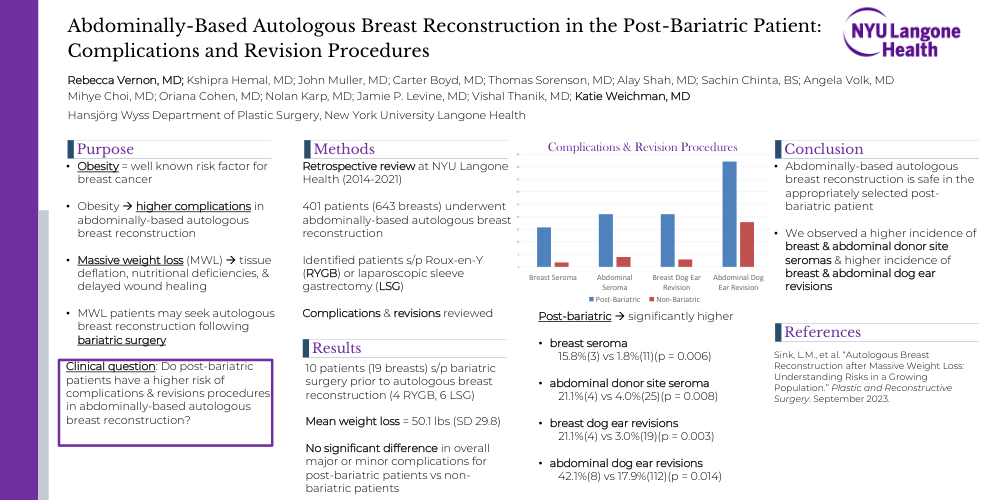
Purpose: Plastic surgeons may encounter patients seeking breast reconstruction who have sustained massive weight loss (MWL) following bariatric surgery. We sought to understand how complications and revision procedures may differ among post-bariatric patients undergoing abdominally-based autologous breast reconstruction.
Methods: A retrospective review of 401 patients (643 breasts) who underwent abdominally-based autologous breast reconstruction from 2014-2021 was conducted at a single institution. Patients who underwent Roux-en-Y gastric bypass (RYGB) or laparoscopic sleeve gastrectomy (LSG) prior to reconstruction were identified. Complications and revision procedures were reviewed.
Results: Ten patients (19 breasts) underwent bariatric surgery prior to autologous breast reconstruction (4 RYGB, 6 LSG). Mean weight loss was 50.1 lbs (SD 29.8), with a trend toward greater weight loss for RYGB (mean 90.5 (SD 20.5)) vs LSG (mean 44 (SD 28.0)) (p = 0.08). There was no significant difference in overall major or minor complications between post-bariatric patients and non-bariatric patients. Post-bariatric patients had a significantly higher rate of breast seroma [3(15.8%) vs 11(1.8%) (p = 0.006)] and abdominal donor site seroma [4(21.1%) vs 25(4.0%) (p = 0.008)]. Post-bariatric patients were significantly more likely to undergo breast dog ear revisions [4(21.1%) vs 19(3.0%) (p = 0.003)] and abdominal dog ear revisions [8(42.1%) vs 112(17.9%) (p = 0.014)] compared to non-bariatric patients.
Conclusions: Abdominally-based autologous breast reconstruction is safe in the appropriately selected post-bariatric patient. In this retrospective cohort, we observed a higher incidence of breast and abdominal donor site seromas as well as a higher incidence of breast and abdominal dog ear revisions.