241 posters, 10 topics, 7 sessions, 899 authors, 296 institutions
ePostersLive by SciGen Technologies S.A. All rights reserved.
The AAPS 103rd Annual Meeting 2025
May 24-27, 2025 | Austin, Texas

D25
Assessment Of Anatomic Eligibility For Robotic-assisted Diep Flap Harvest
Part of Topic
Breast Reconstruction
Population Assessment of Anatomic Eligibility for Robotic-Assisted DIEP Flap
Jacquelyn Roth, BA, Ethan Fung BS, Maxwell Godek BS, Reanna Shah BS, Bernice Z Yu DO, Keisha E Montalmant MD MPH, Peter W Henderson MD MBA FACS
Background
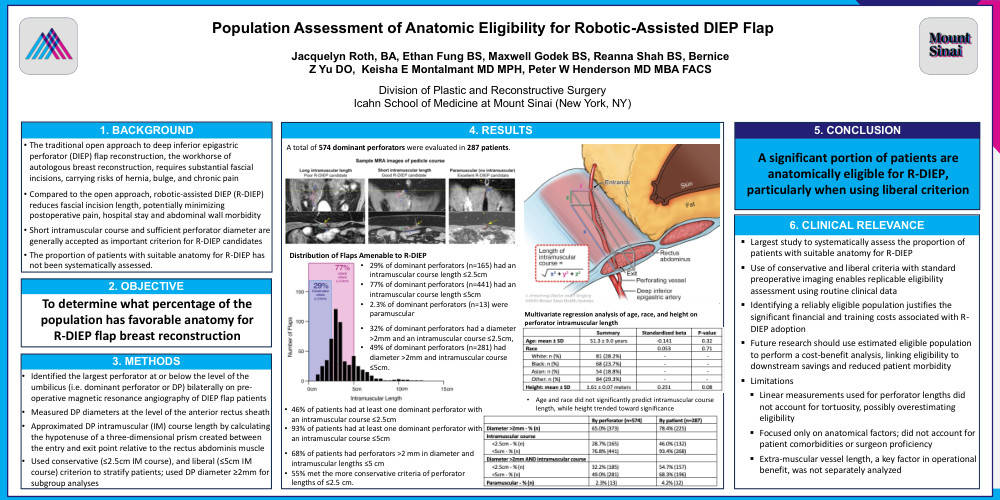
Compared to traditional deep inferior epigastric perforator (DIEP) flap breast reconstruction procedures, robotic-assisted DIEP (R-DIEP) minimizes abdominal wall morbidity by reducing fascial incision length. Optimal R-DIEP candidates have large perforators with short intramuscular courses, but no large-scale studies have quantified their prevalence. The current study aims to identify the proportion of patients who are anatomically eligible for R-DIEP.
Methods
A retrospective review was of patients who underwent magnetic resonance angiography (MRA) perforator mapping prior to DIEP flap breast reconstruction between 2019 and 2023 was conducted. Patient demographics were collected. “Dominant perforator” was defined as the largest perforator at or below the level of the umbilicus. The intramuscular course of each perforator was calculated as the hypotenuse of a theoretical prism connecting its entry and exit points with respect to the rectus abdominis muscle. Perforator diameter was measured at the anterior rectus sheath. “Conservative” (intramuscular course ≤2.5) and “liberal” (intramuscular course ≤5cm) eligibility criteria were applied. Perforator diameter >2mm was used as a secondary criterion.
Results
574 dominant perforators were identified in 287 patients. The average intramuscular length of each perforator was 3.8 +/- 1.9 cm (range: 0-11.0 cm). 29% of dominant perforators (n=165) had an intramuscular course length ≤2.5cm, 77% (n=441) had an intramuscular course length ≤5cm, and 2.3% (n=13) were paramuscular (no intramuscular course). 46% of patients (n=132) had at least one dominant perforator (i.e. left- or right-sided) with an intramuscular course ≤2.5cm, and 93% of patients (n=268) had at least one dominant perforator with an intramuscular course ≤5cm. 31% of dominant perforators (n=185) had a diameter >2mm and an intramuscular course ≤2.5cm, and 49% of dominant perforators (n=281) had diameter >2mm and an intramuscular course ≤5cm.
Conclusion
A substantial portion of the population is anatomically eligible for R-DIEP breast reconstruction, especially when liberal criteria are applied.