241 posters, 10 topics, 7 sessions, 899 authors, 296 institutions
ePostersLive by SciGen Technologies S.A. All rights reserved.
The AAPS 103rd Annual Meeting 2025
May 24-27, 2025 | Austin, Texas

D23
AI-Driven XGBoost Model For Predicting Lymphedema Risk Post-Immediate Lymphatic Reconstruction
Poster Presenter
Authors
Affiliations
Cleveland Clinic, Cleveland Clinic Department of Plastic Surgery
Part of Topic
Breast Reconstruction
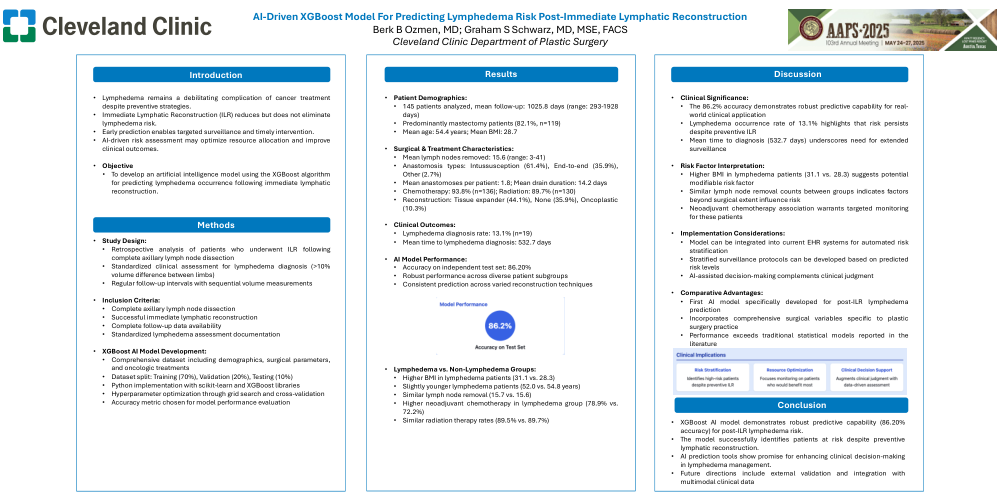
Background: Lymphedema is an important and debilitating complication of cancer treatment, impacting quality of life and increasing healthcare burden. Prevention techniques, coupled with early prediction and intervention are crucial for effective management of this condition. In this study, we develop and validate an artificial intelligence (AI) model using the eXtreme Gradient Boosting (XGBoost) algorithm to predict lymphedema occurrence after immediate lymphatic reconstruction (ILR).
Methods: We analyzed 145 patients who underwent ILR following complete axillary lymph node dissection. The cohort included predominantly mastectomy patients (82.1%, n=119) with a mean age of 54.4 years and mean BMI of 28.7. The dataset was divided into training (70%), validation (20%), and testing (10%) sets. Key variables included patient demographics, surgical parameters, adjuvant therapy details, and clinical outcomes. Lymphedema was diagnosed using standardized clinical assessment, defined as >10% volume difference between limbs. XGBoost AI predictive algorithm is coded in Python by study authors.
Results: The XGBoost model achieved 86.20% accuracy on the independent test set. Among the cohort, 19 patients (13.1%) developed lymphedema during the follow-up period (mean: 1025.8 days). The majority received chemotherapy (93.8%, n=136) and radiation therapy (89.7%, n=130). Tissue expander reconstruction was most common (44.1%, n=64), and sentinel lymph node biopsy was performed in 69.0% (n=100) of cases.
Conclusion: The XGBoost model demonstrates robust predictive capability for post-ILR lymphedema risk, achieving high accuracy in an independent test set. This tool shows promise for identifying high-risk patients who may benefit from enhanced surveillance and early intervention strategies.