241 posters, 10 topics, 7 sessions, 899 authors, 296 institutions
ePostersLive by SciGen Technologies S.A. All rights reserved.
The AAPS 103rd Annual Meeting 2025
May 24-27, 2025 | Austin, Texas

D22
Acellular Dermal Matrix Use In Tissue Expansion Based Breast Reconstruction: An Analysis Of 3,369 Patients Using The Tracking Operations And Outcomes For Plastic Surgeons Database
Part of Topic
Breast Reconstruction
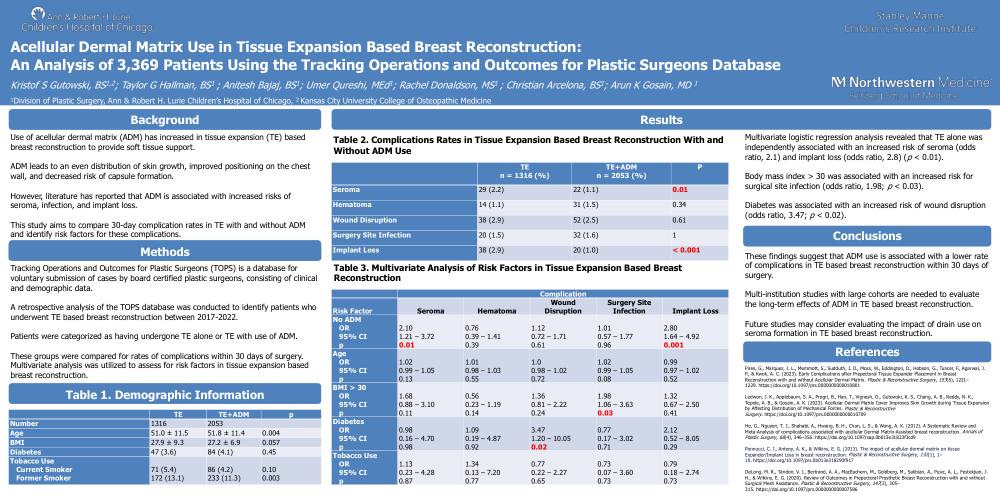
Acellular Dermal Matrix Use in Tissue Expansion Based Breast Reconstruction: An Analysis of 3,369 Patients Using the Tracking Operations and Outcomes for Plastic Surgeons Database.
Background
Use of acellular dermal matrix (ADM) has increased in tissue expansion (TE) based breast reconstruction to provide soft tissue support. ADM leads to an even distribution of skin growth, improved positioning on the chest wall, and decreased risk of capsule formation. However, literature has reported that ADM is associated with increased risks of seroma, infection, and implant loss. This study aims to compare 30-day complication rates in TE with and without ADM and identify risk factors for these complications
Methods
Tracking Operations and Outcomes for Plastic Surgeons (TOPS) is a database for voluntary submission of cases by board certified plastic surgeons, consisting of clinical and demographic data. A retrospective analysis of the TOPS database was conducted to identify patients who underwent TE based breast reconstruction between 2017-2022. Patients were categorized as having undergone TE alone or TE with use of ADM. These groups were compared for rates of complications within 30 days of surgery. Multivariate analysis was utilized to assess for risk factors in tissue expansion based breast reconstruction.
Results
Multivariate logistic regression analysis revealed that TE alone was independently associated with an increased risk of seroma (odds ratio, 2.1) and implant loss (odds ratio, 2.8) (p < 0.01). Body mass index > 30 was associated with an increased risk for surgical site infection (odds ratio, 1.98; p < 0.03). Diabetes was associated with an increased risk of wound disruption (odds ratio, 3.47; p < 0.02).
Conclusions
These findings suggest that ADM use is associated with a lower rate of complications in TE based breast reconstruction within 30 days of surgery. Multi-institution studies with large cohorts are needed to evaluate the long-term effects of ADM in TE based breast reconstruction. Future studies may consider evaluating the impact of drain use on seroma formation in TE based breast reconstruction.