241 posters, 10 topics, 7 sessions, 899 authors, 296 institutions
ePostersLive by SciGen Technologies S.A. All rights reserved.
The AAPS 103rd Annual Meeting 2025
May 24-27, 2025 | Austin, Texas

P35
Outcomes In Post-Mastectomy Breast Reconstruction Utilizing Biosynthetic Mesh: A Meta-Analysis
Part of Topic
Breast Reconstruction
Outcomes in Implant-Based Breast Reconstruction Utilizing Biosynthetic Mesh: A Meta-Analysis
Alisa Arnautovic MD, Sonya Williams BS, Makenna Ash BS, Ambika Menon MD, Orr Shauly, MD, Albert LoskenMD
BACKGROUND
Biosynthetic mesh has become increasingly popular for immediate breast cancer implant-based reconstruction as an alternative to acellular dermal matrix for soft tissue support.
OBJECTIVE
To investigate the various biosynthetic mesh options available as well as complications and outcomes.
METHODS
PubMed (US National Library of Medicine, Bethesda, MD), MEDLINE (US National Library of Medicine), and Embase (Elsevier, Amsterdam, the Netherlands) were systematically reviewed for studies investigating TIGR (Novus Scientific, Uppsala, Sweden), Vicryl (Ethicon, Inc., Raritan, NJ), PDO (Integra LifeSciences, Princeton, NJ), TiLOOP (PFM Medical, Cologne, Germany), Durasorb (Integra LifeSciences, Princeton, NJ), and Galaflex (BD, Franklin Lakes, NJ) meshes, and their associated outcomes. The meta-analysis was completed in accordance with PRISMA guidelines and was performed to determine overall complication rates in patients who underwent breast reconstruction in which a mesh was used. Data were combined by a pooling of proportional outcomes as is inherent to meta-analysis. The heterogeneity of included studies was assessed in terms of Q and I2 statistics.
RESULTS
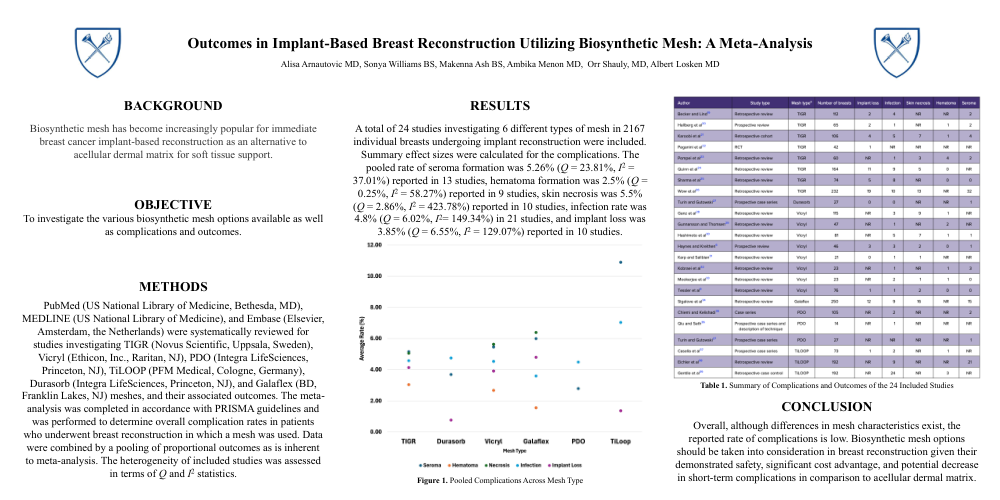
A total of 24 studies investigating 6 different types of mesh in 2167 individual breasts undergoing implant reconstruction were included. Summary effect sizes were calculated for the complications. The pooled rate of seroma formation was 5.26% (Q = 23.81%, I2 = 37.01%) reported in 13 studies, hematoma formation was 2.5% (Q = 0.25%, I2 = 58.27%) reported in 9 studies, skin necrosis was 5.5% (Q = 2.86%, I2 = 423.78%) reported in 10 studies, infection rate was 4.8% (Q = 6.02%, I2= 149.34%) in 21 studies, and implant loss was 3.85% (Q = 6.55%, I2 = 129.07%) reported in 10 studies.
CONCLUSION
Overall, although differences in mesh characteristics exist, the reported rate of complications is low. Biosynthetic mesh options should be taken into consideration in breast reconstruction given their demonstrated safety, significant cost advantage, and potential decrease in short-term complications in comparison to acellular dermal matrix.