241 posters, 10 topics, 7 sessions, 899 authors, 296 institutions
ePostersLive by SciGen Technologies S.A. All rights reserved.
The AAPS 103rd Annual Meeting 2025
May 24-27, 2025 | Austin, Texas

P32
Psychological Outcomes After Mastectomy: Implant Vs. Autologous Reconstruction
Part of Topic
Breast Reconstruction
Patient and Injury-related Predictors of Digit Replantation Failure: Implications of Preoperative Nicotine Dependence
Introduction
-
Breast cancer is associated with significant psychological morbidity which negatively impacts quality of life 1
-
New-onset depression or anxiety increases the risk of breast cancer recurrence and cancer-specific mortality 2
-
Breast reconstruction restores body image and improves psychological well-being, but the impact of the reconstructive modality is unclear 3
-
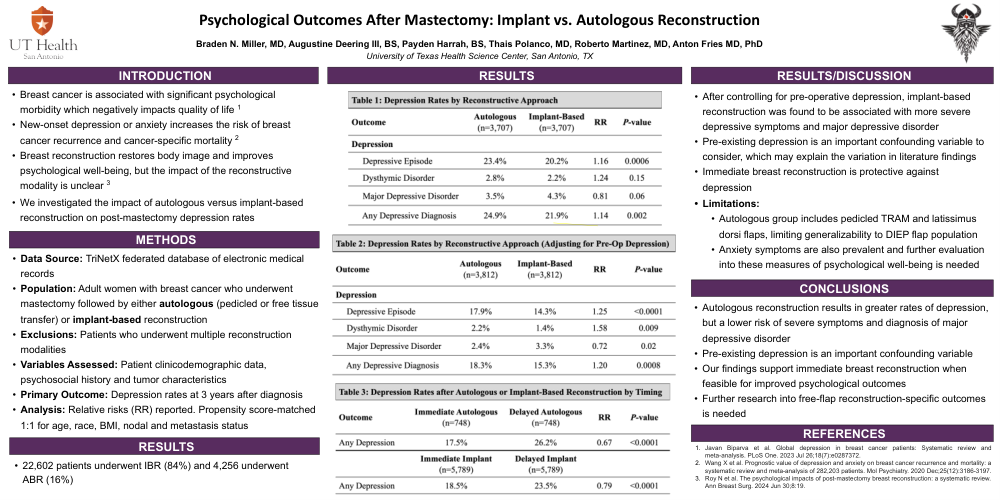
We investigated the impact of autologous versus implant-based reconstruction on post-mastectomy depression rates .
-
Data Source: TriNetX federated database of electronic medical records
-
Population: Adult women with breast cancer who underwent mastectomy followed by either autologous (pedicled or free tissue transfer) or implant-based reconstruction
-
Exclusions: Patients who underwent multiple reconstruction modalities
-
Variables Assessed: Patient clinicodemographic data, psychosocial history and tumor characteristics
-
Primary Outcome: Depression rates at 3 years after diagnosis
-
Analysis: Relative risks (RR) reported. Propensity score-matched 1:1 for age, race, BMI, nodal and metastasis status
-
After controlling for pre-operative depression, implant-based reconstruction was found to be associated with more severe depressive symptoms and major depressive disorder
-
Pre-existing depression is an important confounding variable to consider, which may explain the variation in literature findings
-
Immediate breast reconstruction is protective against depression
-
Limitations:
-
Autologous group includes pedicled TRAM and latissimus dorsi flaps, limiting generalizability to DIEP flap population
-
Anxiety symptoms are also prevalent and further evaluation into these measures of psychological well-being is needed
-
Autologous reconstruction results in greater rates of depression, but a lower risk of severe symptoms and diagnosis of major depressive disorder
-
Pre-existing depression is an important confounding variable
-
Our findings support immediate breast reconstruction when feasible for improved psychological outcomes
-
Further research into free-flap reconstruction-specific outcomes is needed