241 posters, 10 topics, 7 sessions, 899 authors, 296 institutions
ePostersLive by SciGen Technologies S.A. All rights reserved.
The AAPS 103rd Annual Meeting 2025
May 24-27, 2025 | Austin, Texas

P25
Race And Social Vulnerability As Predictors Of Breast Reconstruction Outcomes
Poster Presenter
Part of Topic
Breast Reconstruction
Background:
•Post-mastectomy breast reconstruction has been shown to improve physical and psychosocial well-being
•Although reconstruction rates have increased over time, disparities remain particularly among racial minorities and patients with lower socioeconomic status
Purpose:
•Analyze the impact of race and social vulnerability on outcomes of post-mastectomy breast reconstruction
Methods:
•Retrospective cohort study of patients undergoing first-time post-mastectomy breast reconstruction at a single institution from 2016-2023
•Data included: demographics, social vulnerability index (SVI), preoperative treatment with radiation/chemotherapy reconstruction methods, and outcomes
•Statistical analysis with independent t-tests and Chi-square
•Stratified by reconstructive methods
Results:
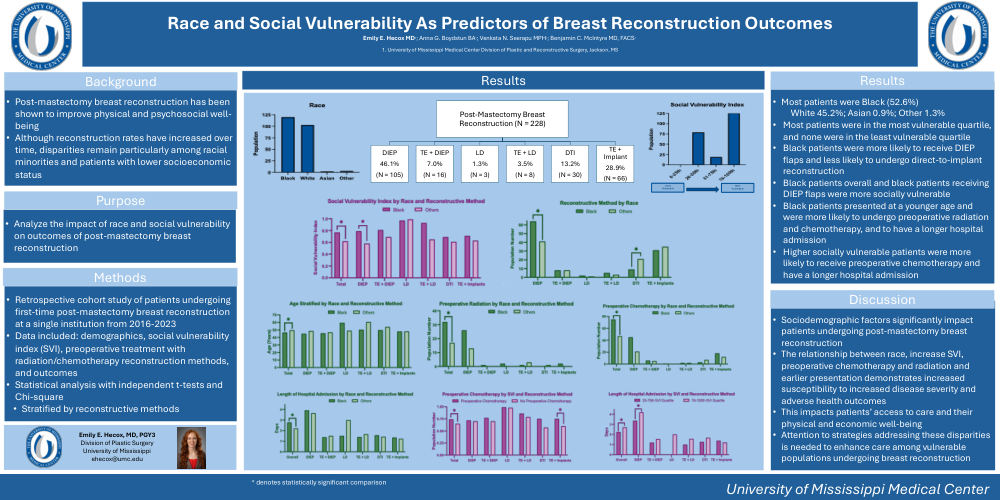
•Most patients were Black (52.6%) White 45.2%; Asian 0.9%; Other 1.3%
•Most patients were in the most vulnerable quartile, and none were in the least vulnerable quartile
•Black patients were more likely to receive DIEP flaps and less likely to undergo direct-to-implant reconstruction
•Black patients overall and black patients receiving DIEP flaps were more socially vulnerable
•Black patients presented at a younger age and were more likely to undergo preoperative radiation and chemotherapy, and to have a longer hospital admission
•Higher socially vulnerable patients were more likely to receive preoperative chemotherapy and have a longer hospital admission
Discussion:
•Sociodemographic factors significantly impact patients undergoing post-mastectomy breast reconstruction
•The relationship between race, increase SVI, preoperative chemotherapy and radiation and earlier presentation demonstrates increased susceptibility to increased disease severity and adverse health outcomes
•This impacts patients’ access to care and their physical and economic well-being
•Attention to strategies addressing these disparities is needed to enhance care among vulnerable populations undergoing breast reconstruction