241 posters, 10 topics, 7 sessions, 899 authors, 296 institutions
ePostersLive by SciGen Technologies S.A. All rights reserved.
The AAPS 103rd Annual Meeting 2025
May 24-27, 2025 | Austin, Texas

D43
To Stack Or Not To Stack: An Institutional Experience With Autologous Stacked-flaps For Breast Reconstruction.
Poster Presenter
Part of Topic
Breast Reconstruction
To Stack or Not to Stack: An Institutional Experience with Autologous Stacked-flaps for Breast Reconstruction.
Idanis Perez-Alvarez, Annie M Fritsch, Nikki Rezania, Keith Hood, David Kurlander, George Kokosis, Deana Shenaq
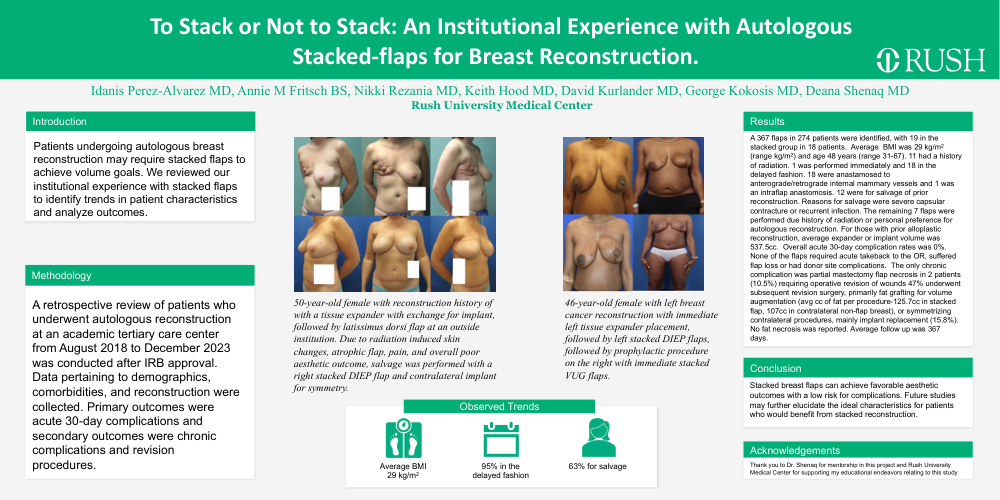
Background: Patients undergoing autologous breast reconstruction may require stacked flaps to achieve volume goals. We reviewed our institutional experience with stacked flaps to identify trends in patient characteristics and analyze outcomes.
Methods: A retrospective review of patients who underwent autologous reconstruction at an academic tertiary care center from August 2018 to December 2023 was conducted after IRB approval. Data pertaining to demographics, comorbidities, and reconstruction were collected. Primary outcomes were acute 30-day complications and secondary outcomes were chronic complications and revision procedures.
Results: 367 flaps in 274 patients were identified, with 19 in the stacked group in 18 patients. Average BMI was 29 kg/m2 (range 22-36 kg/m2) and age 48 years (range 31-67). 11 had a history of radiation. 1 was performed immediately and 18 in the delayed fashion. 18 were anastamosed to anterograde/retrograde internal mammary vessels and 1 was an intraflap anastomosis. 12 were for salvage of prior reconstruction. Reasons for salvage were severe capsular contracture or recurrent infection. The remaining 7 flaps were performed due history of radiation or personal preference for autologous reconstruction. For those with prior alloplastic reconstruction, average expander or implant volume was 537.5cc. Overall acute 30-day complication rates was 0%. None of the flaps required acute takeback to the OR, suffered flap loss or had donor site complications. The only chronic complication was partial mastectomy flap necrosis in 2 patients (10.5%) requiring operative revision of wounds 47% underwent subsequent revision surgery, primarily fat grafting for volume augmentation (avg cc of fat per procedure-125.7cc in stacked flap, 107cc in contralateral non-flap breast), or symmetrizing contralateral procedures, mainly implant replacement (15.8%). No fat necrosis was reported. Average follow up was 367 days.
Conclusions: Stacked breast flaps can achieve favorable aesthetic outcomes with a low risk for complications. Future studies may further elucidate the ideal characteristics for patients who would benefit from stacked reconstruction.