241 posters, 10 topics, 7 sessions, 899 authors, 296 institutions
ePostersLive by SciGen Technologies S.A. All rights reserved.
The AAPS 103rd Annual Meeting 2025
May 24-27, 2025 | Austin, Texas

D42
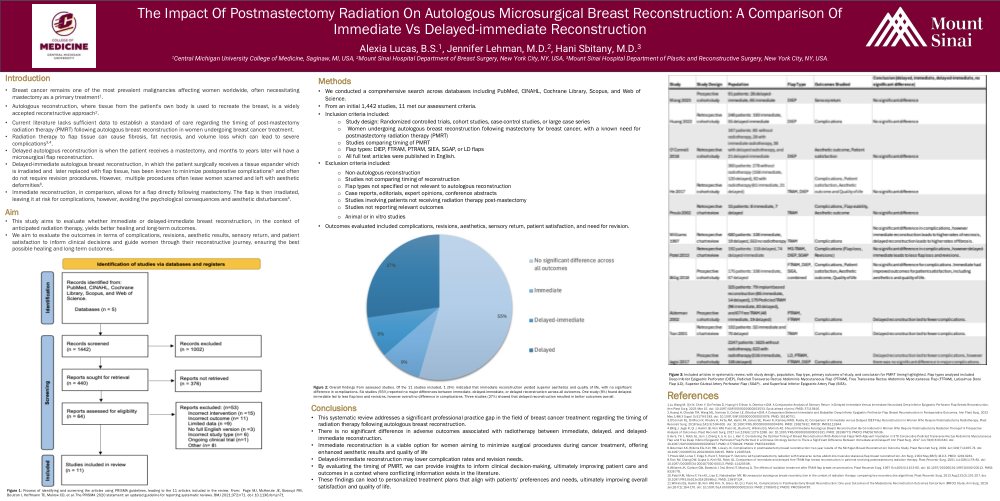
The Impact Of Postmastectomy Radiation On Autologous Microsurgical Breast Reconstruction: A Comparison Of Immediate Vs Delayed-immediate Reconstruction
Part of Topic
Breast Reconstruction
Introduction
• Breast cancer remains one of the most prevalent malignancies affecting women worldwide, often necessitating mastectomy as a primary treatment.
• Autologous reconstruction, where tissue from the patients own body is used to recreate the breast, is a widely accepted reconstructive approach.
• Current literature lacks sufficient data to establish a standard of care regarding the timing of post-mastectomy radiation therapy (PMRT) following autologous breast reconstruction in women undergoing breast cancer treatment.
• Radiation therapy to flap tissue can cause fibrosis, fat necrosis, and volume loss which can lead to severe complications4.
• Delayed autologous reconstruction is when the patient receives a mastectomy, and months to years later will have a microsurgical flap reconstruction.
• Delayed-immediate autologous breast reconstruction, in which the patient surgically receives a tissue expander which is irradiated and later replaced with flap tissue, has been known to minimize postoperative complications2 and often do not require revision procedures. However, multiple procedures often leave women scarred and left with aesthetic deformities.
• Immediate reconstruction, in comparison, allows for a flap directly following mastectomy. The flap is then irradiated, leaving it at risk for complications, however, avoiding the psychological consequences and aesthetic disturbances4.
Aim
• This study aims to evaluate whether immediate or delayed-immediate breast reconstruction, in the context of anticipated radiation therapy, yields better healing and long-term outcomes.
• We aim to evaluate the outcomes in terms of complications, revisions, aesthetic results, sensory return, and patient satisfaction to inform clinical decisions and guide women through their reconstructive journey, ensuring the best possible healing and long-term outcomes.
Methods
• We conducted a comprehensive search across databases including PubMed, CINAHL, Cochrane Library, Scopus, and Web of Science.
• From an initial 1,442 studies, 11 met our assessment criteria.
• Inclusion criteria included:
o Study design: Randomized controlled trials, cohort studies, case-control studies, or large case series
o Women undergoing autologous breast reconstruction following mastectomy for breast cancer, with a known need for postmastectomy radiation therapy (PMRT)
o Studies comparing timing of PMRT
o Flap types: DIEP, FTRAM, PTRAM, SIEA, SGAP, or LD flaps
o All full text articles were published in English.
• Exclusion criteria included:
o Non-autologous reconstruction
o Studies not comparing timing of reconstruction
o Flap types not specified or not relevant to autologous reconstruction
o Case reports, editorials, expert opinions, conference abstracts
o Studies involving patients not receiving radiation therapy post-mastectomy
o Studies not reporting relevant outcomes
o Animal or in vitro studies
• Outcomes evaluated included complications, revisions, aesthetics, sensory return, patient satisfaction, and need for revision.
Results
● Of the 11 studies included, 1 (9%) indicated that immediate reconstruction yielded superior aesthetics and quality of life, with no significant difference in complications.
● Seven studies (63.6%) reported no major differences between immediate, delayed-immediate, or delayed reconstruction across all outcomes.
● Three studies (27.3%) showed that delayed reconstruction resulted in better outcomes for complications
● Notably, one study found that immediate reconstruction leads to higher rates of necrosis, while delayed reconstruction leads to higher rates of fibrosis.
● Another study found no significant differences in complications, however delayed-immediate reconstruction led to less flap loss and revisions.
● One study found that although delayed reconstruction led to fewer complications, there was no significant difference in the number of major complications.
Conclusion
• This systematic review addresses a significant professional practice gap in the field of breast cancer treatment regarding the timing of radiation therapy following autologous breast reconstruction.
• There is no significant difference in adverse outcomes associated with radiotherapy between immediate, delayed. and delayed-immediate reconstruction.
• Immediate reconstruction is a viable option for women aiming to minimize surgical procedures during cancer treatment, offering enhanced aesthetic results and quality of life
• Delayed-immediate reconstruction may lower complication rates and revision needs.
• By evaluating the timing of PMRT, we can provide insights to inform clinical decision-making, ultimately improving patient care and outcomes in a context where conflicting information exists in the literature.
• These findings can lead to personalized treatment plans that align with patients preferences and needs, ultimately improving overall satisfaction and quality of life.