241 posters, 10 topics, 7 sessions, 899 authors, 296 institutions
ePostersLive by SciGen Technologies S.A. All rights reserved.
The AAPS 103rd Annual Meeting 2025
May 24-27, 2025 | Austin, Texas

D37
Short-fascial Incision And Drainless Abdomen In DIEP Flap-based Breast Reconstruction Decreases Postoperative Narcotic Use And Shortens Length Of Stay
Poster Presenter
Authors
Haley Kenner, Alma Jukic, Santana Solomon, Michael Mazarei, Taylor Waitt, Michelle Oberoi, Sarth Raj, Michel Saint-Cyr
Affiliations
University of Arizona College of Medicine - Phoenix, University of Arizona College of Medicine - Phoenix, Phoenix, Arizona, Division of Plastic Surgery, Baylor Scott & White Health, Temple, Texas, Division of Plastic Surgery, Banner MD Anderson Cancer Center at Banner Gateway Medical Center, Gilbert, Arizona
Part of Topic
Breast Reconstruction
Short-fascial Incision And Drainless Abdomen In DIEP Flap-Based Breast Reconstruction Decreases Postoperative Narcotic Use and Shortens Length of Stay
Haley Kenner, BS1, Alma Jukic, BA1, Santana Solomon, BS1, Michael Mazarei, BA1, Taylor Waitt, MD3, Michelle Oberoi, MD3, Sarth Raj, MD3, Michel Saint-Cyr, MD, MBA2
1University of Arizona College of Medicine – Phoenix, Phoenix, AZ, 2Division of Plastic Surgery, Banner MD Anderson Cancer Center, Gilbert, AZ, 3Division of Plastic Surgery, Baylor Scott & White Health, Temple, TX
Background & Purpose
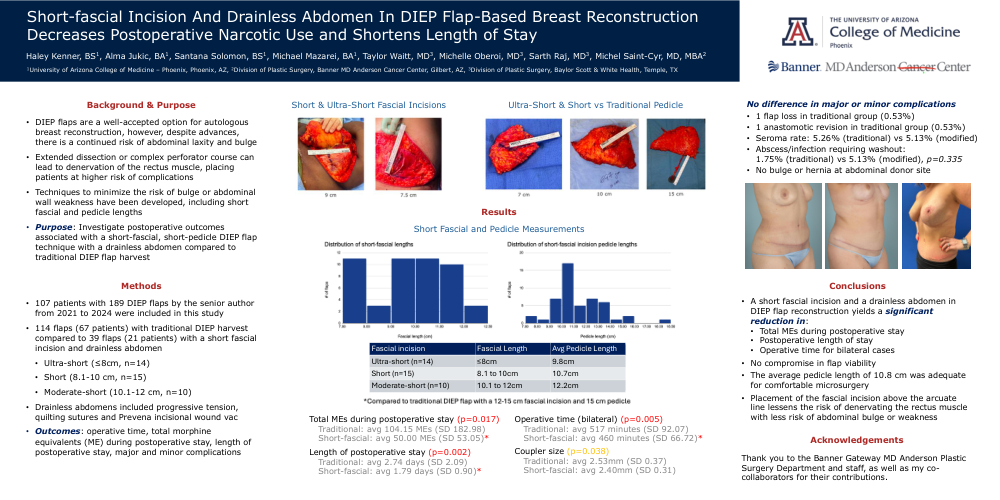
• DIEP flaps are a well-accepted option for autologous breast reconstruction, however, despite advances, there is a continued risk of abdominal laxity and bulge • Extended dissection or complex perforator course can lead to denervation of the rectus muscle, placing patients at higher risk of complications • Techniques to minimize the risk of bulge or abdominal wall weakness have been developed, including short fascial and pedicle lengths • Purpose: Investigate postoperative outcomes associated with a short-fascial, short-pedicle DIEP flap technique with a drainless abdomen compared to traditional DIEP flap harvest
Methods
• 107 patients with 189 DIEP flaps by the senior author from 2021 to 2024 were included in this study • 114 flaps (67 patients) with traditional DIEP harvest compared to 39 flaps (21 patients) with a short fascial incision and drainless abdomen • Ultra-short (≤8cm, n=14) • Short (8.1-10 cm, n=15) • Moderate-short (10.1-12 cm, n=10) • Drainless abdomens included progressive tension, quilting sutures and Prevena incisional wound vac • Outcomes: operative time, total morphine equivalents (ME) during postoperative stay, length of postoperative stay, major and minor complications
Results
Total MEs during postoperative stay (p=0.017) Traditional: avg 104.15 MEs (SD 182.98) Short-fascial: avg 50.00 MEs (SD 53.05)* Length of postoperative stay (p=0.002) Traditional: avg 2.74 days (SD 2.09) Short-fascial: avg 1.79 days (SD 0.90)* Operative time (bilateral) (p=0.005) Traditional: avg 517 minutes (SD 92.07) Short-fascial: avg 460 minutes (SD 66.72)* Coupler size (p=0.038) Traditional: avg 2.53mm (SD 0.37) Short-fascial: avg 2.40mm (SD 0.31)
No difference in major or minor complications • 1 flap loss in traditional group (0.53%) • 1 anastomotic revision in traditional group (0.53%) • Seroma rate: 5.26% (traditional) vs 5.13% (modified) • Abscess/infection requiring washout: 1.75% (traditional) vs 5.13% (modified), p=0.335 • No bulge or hernia at abdominal donor site
Conclusions
• A short fascial incision and a drainless abdomen in DIEP flap reconstruction yields a significant reduction in: • Total MEs during postoperative stay • Postoperative length of stay • Operative time for bilateral cases • No compromise in flap viability • The average pedicle length of 10.8 cm was adequate for comfortable microsurgery • Placement of the fascial incision above the arcuate line lessens the risk of denervating the rectus muscle with less risk of abdominal bulge or weakness
Acknowledgements
Thank you to the Banner Gateway MD Anderson Plastic Surgery Department and staff, as well as my co-collaborators for their contributions.