241 posters, 10 topics, 7 sessions, 899 authors, 296 institutions
ePostersLive by SciGen Technologies S.A. All rights reserved.
The AAPS 103rd Annual Meeting 2025
May 24-27, 2025 | Austin, Texas

D34
Oncoplastic Reduction Mammoplasty: A Means To Decrease The Incidence Of Breast Lymphedema
Poster Presenter
Authors
Affiliations
Part of Topic
Breast Reconstruction
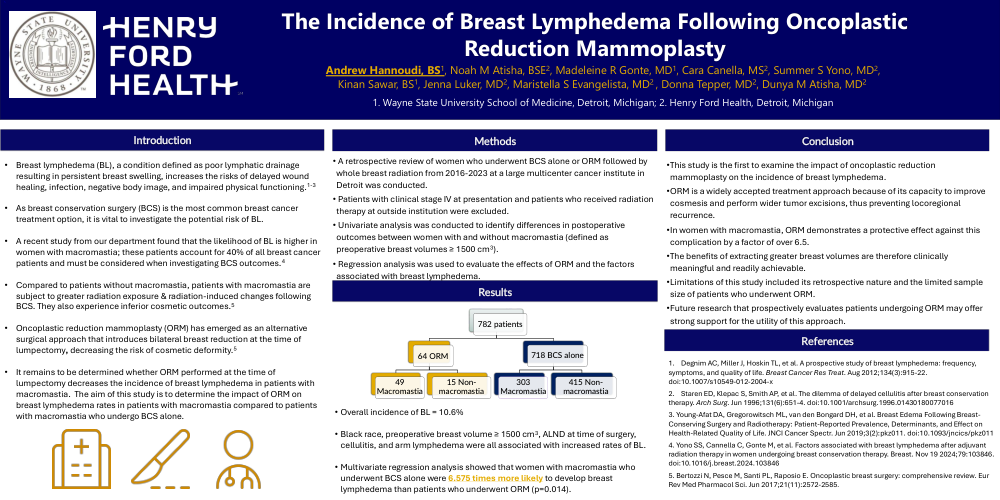
The Incidence of Breast Lymphedema Following Oncoplastic Reduction Mammoplasty
A retrospective review of women who underwent BCS alone or ORM followed by whole breast radiation from 2016-2023 at a large multicenter cancer institute in Detroit was conducted.
Patients with clinical stage IV at presentation and patients who received radiation therapy at outside institution were excluded.
Univariate analysis was conducted to identify differences in postoperative outcomes between women with and without macromastia (defined as preoperative breast volumes ≥ 1500 cm3).
Regression analysis was used to evaluate the effects of ORM and the factors associated with breast lymphedema.
Results
Overall incidence of BL = 10.6%
Black race, preoperative breast volume ≥ 1500 cm3, ALND at time of surgery, cellulitis, and arm lymphedema were all associated with increased rates of BL.
Multivariate regression analysis showed that women with macromastia who underwent BCS alone were 6.575 times more likely to develop breast lymphedema than patients who underwent ORM (p=0.014).
Conclusion
This study is the first to examine the impact of oncoplastic reduction mammoplasty on the incidence of breast lymphedema.
ORM is a widely accepted treatment approach because of its capacity to improve cosmesis and perform wider tumor excisions, thus preventing locoregional recurrence.
In women with macromastia, ORM demonstrates a protective effect against this complication by a factor of over 6.5.
The benefits of extracting greater breast volumes are therefore clinically meaningful and readily achievable.
Limitations of this study included its retrospective nature and the limited sample size of patients who underwent ORM.
Future research that prospectively evaluates patients undergoing ORM may offer strong support for the utility of this approach.