241 posters, 10 topics, 7 sessions, 899 authors, 296 institutions
ePostersLive by SciGen Technologies S.A. All rights reserved.
The AAPS 103rd Annual Meeting 2025
May 24-27, 2025 | Austin, Texas

D32
National Trends In Autologous Breast Reconstruction With Free Tissue Transfer
Poster Presenter
Part of Topic
Breast Reconstruction
National Trends in Autologous Breast Reconstruction with Free Tissue Transfer
Introduction
• Autologous breast reconstruction (ABR) offers durable outcomes and high patient satisfaction1,2
• National trends in ABR postoperative outcomes over time remain incompletely characterized
• This study analyzes a 12-year national cohort to evaluate temporal trends in ABR utilization, patient characteristics, and short-term outcomes
Methods
• Sample: 20,991 patients undergoing free flap ABR (2011-2022 NSQIP data)
• CPT Code: 19364 for free flap ABR
• Exclusions: Emergency cases
• Cohorts: Stratified into 3-year intervals (2011–2013, 2014–2016, 2017–2019, 2020–2022)
• Outcomes: 30-day all-cause complications, reoperation, readmission, and surgical site infection (SSI)
• Analysis: Compared cohorts utilizing multivariable logistic regression for adjusted odds ratios; marginal effects for predicted complication risk (p < 0.05 significant)
Results
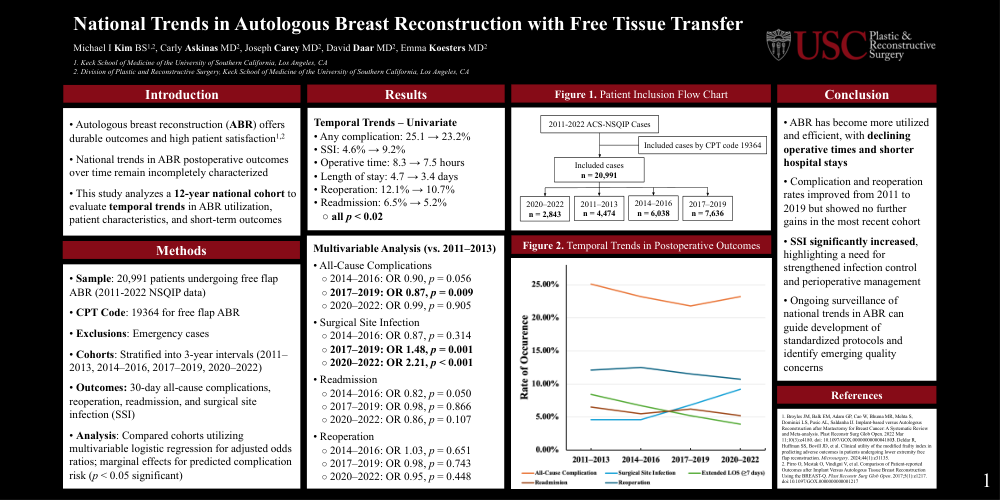
Temporal Trends – Univariate
• Any complication: 25.1 → 23.2%
• SSI: 4.6% → 9.2%
• Operative time: 8.3 → 7.5 hours
• Length of stay: 4.7 → 3.4 days
• Reoperation: 12.1% → 10.7%
• Readmission: 6.5% → 5.2%
○ all p < 0.02
Multivariable Analysis (vs. 2011–2013)
• All-Cause Complications
○ 2014–2016: OR 0.90, p = 0.056
○ 2017–2019: OR 0.87, p = 0.009
○ 2020–2022: OR 0.99, p = 0.905
• Surgical Site Infection
○ 2014–2016: OR 0.87, p = 0.314
○ 2017–2019: OR 1.48, p = 0.001
○ 2020–2022: OR 2.21, p < 0.001
• Readmission
○ 2014–2016: OR 0.82, p = 0.050
○ 2017–2019: OR 0.98, p = 0.866
○ 2020–2022: OR 0.86, p = 0.107
• Reoperation
○ 2014–2016: OR 1.03, p = 0.651
○ 2017–2019: OR 0.98, p = 0.743
○ 2020–2022: OR 0.95, p = 0.448
Conclusion
• ABR has become more utilized and efficient, with declining operative times and shorter hospital stays
• Complication and reoperation rates improved from 2011 to 2019 but showed no further gains in the most recent cohort
• SSI significantly increased, highlighting a need for strengthened infection control and perioperative management
• Ongoing surveillance of national trends in ABR can guide development of standardized protocols and identify emerging quality concerns