241 posters, 10 topics, 7 sessions, 899 authors, 296 institutions
ePostersLive by SciGen Technologies S.A. All rights reserved.
The AAPS 103rd Annual Meeting 2025
May 24-27, 2025 | Austin, Texas

D28
Indications Of The Latissimus Dorsi Flap In A Microsurgery Breast Reconstruction Practice
Poster Presenter
Authors
Affiliations
Part of Topic
Breast Reconstruction
Introduction:
Breast reconstruction following a mastectomy is a critical component of comprehensive care for breast cancer patients by improving both physical and psychological well-being. The latissimus dorsi (LD) flap has been a longstanding, reliable donor site in breast reconstruction due to its robust vascular supply and versatility, particularly when other donor sites are unsuitable. However, with advancements in microsurgical techniques, there has been a shift towards alternative donor sites such as the deep inferior epigastric perforator (DIEP) flap, as they offer more natural outcomes with fewer donor-site morbidities.
Despite this trend, the LD flap remains valuable in specific scenarios, particularly for patients who are not candidates for free flap surgery due to medical comorbidities, insufficient donor tissue, or previous abdominal surgeries. It also continues to play a role in partial breast reconstruction and salvage surgeries, offering consistent results. As such, the role of the LD flap in modern microsurgical practices should not be dismissed but rather thoughtfully integrated into comprehensive reconstructive strategies, tailored to individual patient needs and circumstances to optimize outcomes.
Methods:
An IRB-approved retrospective review of patient data stored in a REDCap database was conducted, covering the period from January 2012 to December 2022. The study cohort consisted of 61 patients who underwent a total of 76 latissimus dorsi (LD) flap breast reconstructions at a single institution.
We analyzed patients' demographic and clinical characteristics, with specific attention to age, comorbidities, and surgical indications. Comorbidities included hypertension, diabetes, history of deep vein thrombosis (DVT) or pulmonary embolism (PE), and previous radiation therapy. These variables were selected based on their known potential to impact surgical outcomes and complication rates. Age was also examined as an important factor that could influence both the selection of surgical techniques and recovery times.
Results:
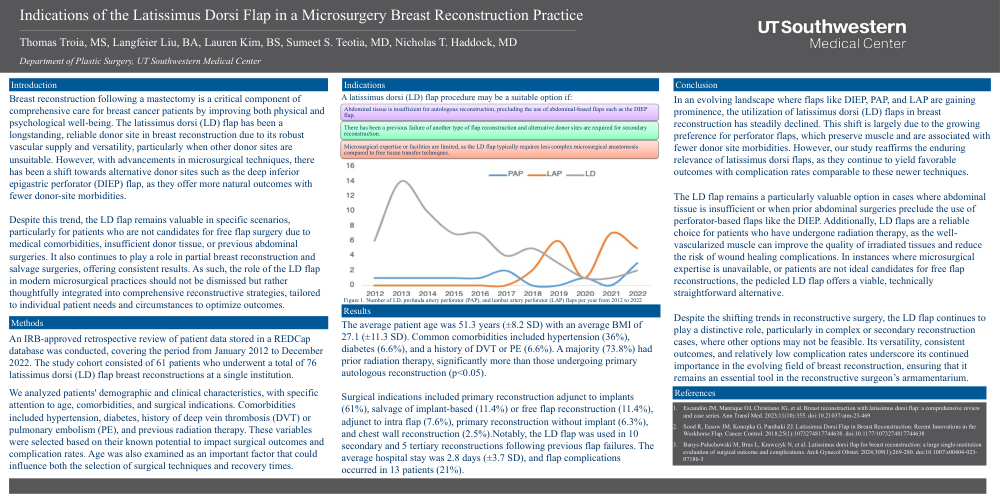
The average patient age was 51.3 years (±8.2 SD) with an average BMI of 27.1 (±11.3 SD). Common comorbidities included hypertension (36%), diabetes (6.6%), and a history of DVT or PE (6.6%). A majority (73.8%) had prior radiation therapy, significantly more than those undergoing primary autologous reconstruction (p<0.05).
Surgical indications included primary reconstruction adjunct to implants (61%), salvage of implant-based (11.4%) or free flap reconstruction (11.4%), adjunct to intra flap (7.6%), primary reconstruction without implant (6.3%), and chest wall reconstruction (2.5%).Notably, the LD flap was used in 10 secondary and 5 tertiary reconstructions following previous flap failures. The average hospital stay was 2.8 days (±3.7 SD), and flap complications occurred in 13 patients (21%).
Conclusion:
In an evolving landscape where flaps like DIEP, PAP, and LAP are gaining prominence, the utilization of latissimus dorsi (LD) flaps in breast reconstruction has steadily declined. This shift is largely due to the growing preference for perforator flaps, which preserve muscle and are associated with fewer donor site morbidities. However, our study reaffirms the enduring relevance of latissimus dorsi flaps, as they continue to yield favorable outcomes with complication rates comparable to these newer techniques.
The LD flap remains a particularly valuable option in cases where abdominal tissue is insufficient or when prior abdominal surgeries preclude the use of perforator-based flaps like the DIEP. Additionally, LD flaps are a reliable choice for patients who have undergone radiation therapy, as the well-vascularized muscle can improve the quality of irradiated tissues and reduce the risk of wound healing complications. In instances where microsurgical expertise is unavailable, or patients are not ideal candidates for free flap reconstructions, the pedicled LD flap offers a viable, technically straightforward alternative.
Despite the shifting trends in reconstructive surgery, the LD flap continues to play a distinctive role, particularly in complex or secondary reconstruction cases, where other options may not be feasible. Its versatility, consistent outcomes, and relatively low complication rates underscore its continued importance in the evolving field of breast reconstruction, ensuring that it remains an essential tool in the reconstructive surgeon’s armamentarium.