203 posters, 14 topics, 5 sessions, 817 authors, 256 institutions
ePostersLive by SciGen Technologies S.A. All rights reserved.
The AAPS 102nd Annual Meeting
May 18-21, 2024 | The Westin Copley Place, Boston, MA

D38
An Algorithm Utilizing Premaxillary Osteotomy In The Management Of Patients With Bilateral Cleft Lip
Poster Presenter
Authors
Affiliations
Part of Topic
Craniofacial/Peds
An Algorithm Utilizing Premaxillary Osteotomy in the Management of Patients with Bilateral Cleft Lip
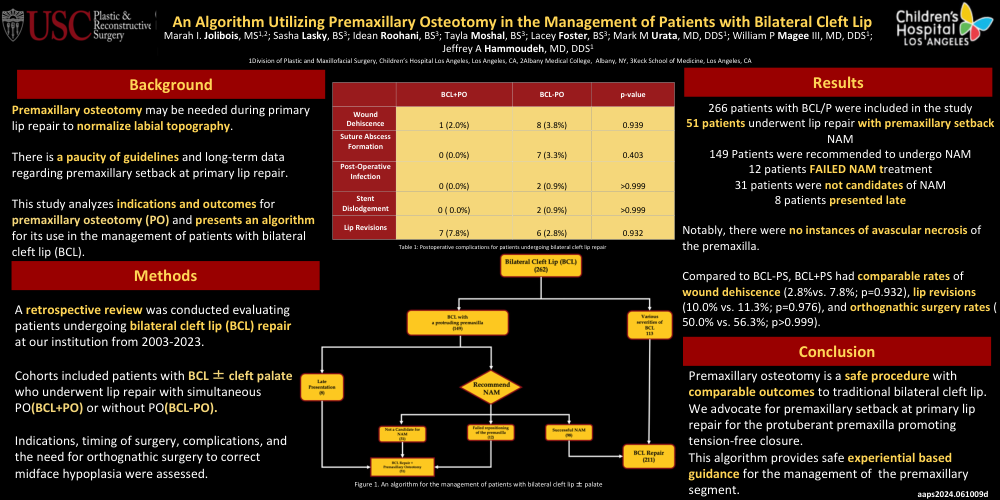
Purpose: This study analyzes indications and outcomes for premaxillary osteotomy (PO) and presents an algorithm for its use in the management of patients with bilateral cleft lip (BCL).
Methods: A retrospective review was conducted evaluating patients undergoing lip repair at our institution from 2003-2023. Cohorts included patients with BCL ± cleft palate who underwent lip repair with simultaneous PO(BCL+PO) or without PO(BCL-PO). Indications, timing of surgery, complications, and the need for orthognathic surgery to correct midface hypoplasia were assessed.
Results: 1,090 patients underwent cleft lip repair,of which 266 patients with BCL/P met inclusion criteria. Fifty-one patients required PO leading to the development of a management algorithm(Figure 1). One hundred forty-nine patients with complete BCL/P were recommended NAM. For patients with a protruding premaxilla who failed treatment (n=12) or not suitable NAM candidates (n=31), premaxillary setback was recommended (6.056±4.682 months). Patients with a protruding premaxilla with late presentation were also recommended PO(n=8, 12.977± 8.196 months). Across all patients, complications included wound dehiscence(n=3) and abscess formation (n=2). Notably, no cases of avascular necrosis of the premaxilla. Compared to BCL-PO, BCL+PO had comparable rates of wound dehiscence (2.7%vs. 7.7%; p=0.932), lip revisions(10.0% vs. 11.3%; p=0.976), and orthognathic surgery rates(50.0% vs. 56.3%; p>0.999).
Conclusion: This algorithm provides safe experiential-based guidance for the management of the premaxillary segment.