203 posters, 14 topics, 5 sessions, 817 authors, 256 institutions
ePostersLive by SciGen Technologies S.A. All rights reserved.
The AAPS 102nd Annual Meeting
May 18-21, 2024 | The Westin Copley Place, Boston, MA

D103
Automated Carving Of Auricular Frameworks In Microtia Reconstruction
Poster Presenter
Part of Topic
Craniofacial/Peds
Automated Carving of Auricular Frameworks in Microtia Reconstruction
Background:
•The current gold standard of microtia reconstruction involves autologous rib harvest with manual framework production – a technically challenging and lengthy procedure.
•Recent implantation of cadaveric costal cartilage (CCC) grafts by senior author (NB) has shown to be a safe and effective alternative. This approach eliminates autologous harvest, leading to decreased donor site morbidity and time under anesthesia. However, this method still requires intraoperative manual carving.
Objective:
•To assess the feasibility and efficiency of 3D automated milling of cadaveric costal cartilage for auricular framework production
Methods:
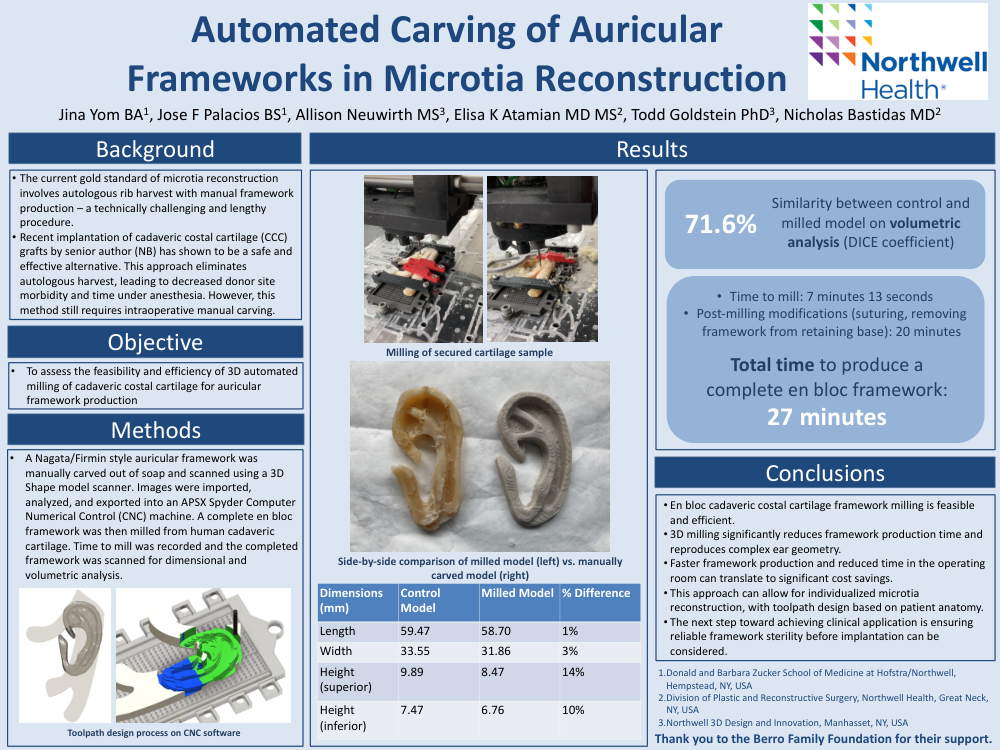
•A Nagata/Firmin style auricular framework was manually carved out of soap and scanned using a 3D Shape model scanner. Images were imported, analyzed, and exported into an APSX Spyder Computer Numerical Control (CNC) machine. A complete en bloc framework was then milled from human cadaveric cartilage. Time to mill was recorded and the completed framework was scanned for dimensional and volumetric analysis.
Results:
71.6% similarity between control and milled model on volumetric analysis (DICE coefficient).
Time to mill: 7 minutes 13 seconds
Post-milling modifications (suturing, removing framework from retaining base): 20 minutes
Total time to produce a complete en bloc framework: 27 minutes
Conclusions:
•En bloc cadaveric costal cartilage framework milling is feasible and efficient.
•3D milling significantly reduces framework production time and reproduces complex ear geometry.
•Faster framework production and reduced time in the operating room can translate to significant cost savings.
•This approach can allow for individualized microtia reconstruction, with toolpath design based on patient anatomy.
•The next step toward achieving clinical application is ensuring reliable framework sterility before implantation can be considered.