203 posters, 14 topics, 5 sessions, 817 authors, 256 institutions
ePostersLive by SciGen Technologies S.A. All rights reserved.
The AAPS 102nd Annual Meeting
May 18-21, 2024 | The Westin Copley Place, Boston, MA

D107
Does Craniosynostosis Affect Orbital Volume In Children With Graves’ Disease?
Part of Topic
Craniofacial/Peds
Does Craniosynostosis Affect Orbital Volume in Children with Graves’ Disease?
INTRODUCTION
Graves’ Disease (GD)
•Most common cause of hyperthyroidism
•Graves’ ophthalmopathy is present in 30% of patients with GD
Case:
•5-year-old with history of GD who failed medical treatment
•Consulted for possible orbital decompression
•CT findings: pansynostosis + signs of elevated ICP
•Overall impression: phenotypically similar to Crouzon syndrome
Hypotheses
1.Higher incidence of craniosynostosis in pediatric GD
2.Early suture fusion reduces orbital volume
METHODS
Retrospective Review
GD group:
•<18 years old
•+ head CT
Control group:
•age-, sex, -race-matched
•+ head CT
Suture Fusion Grading
Volumetric Analysis
•Orbital volume
•Sphenoid Volume
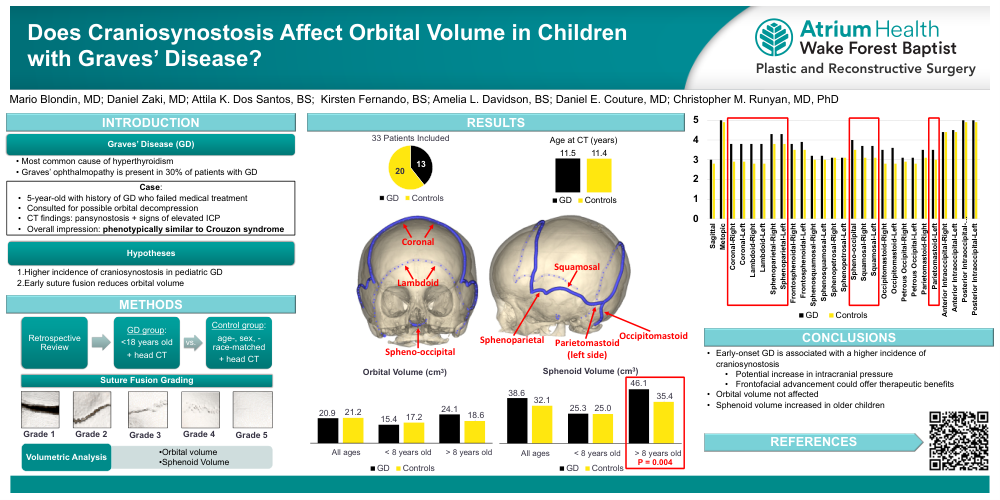
RESULTS
*See tables and figures.
CONCLUSIONS
Early-onset GD is associated with a higher incidence of craniosynostosis
•Potential increase in intracranial pressure
•Frontofacial advancement could offer therapeutic benefits
Orbital volume not affected
Sphenoid volume increased in older children