203 posters, 14 topics, 5 sessions, 817 authors, 256 institutions
ePostersLive by SciGen Technologies S.A. All rights reserved.
The AAPS 102nd Annual Meeting
May 18-21, 2024 | The Westin Copley Place, Boston, MA

D37
An Evaluation Of Rapid Palatal Expansion On Velopharyngeal Insufficiency And Speech Outcomes
Poster Presenter
Authors
Affiliations
Part of Topic
Craniofacial/Peds
An Evaluation of Rapid Palatal Expansion on Velopharyngeal Insufficiency and Speech Outcomes
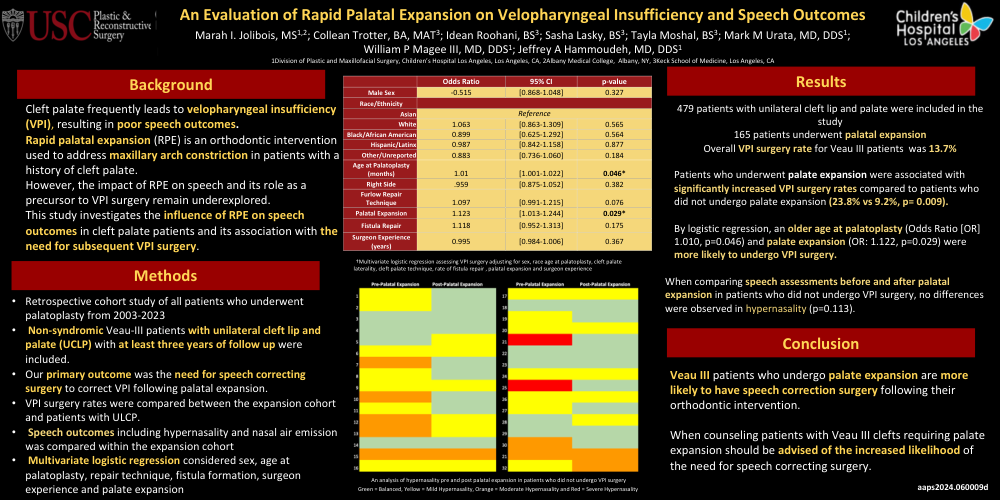
Purpose: This study investigates the effect of rapid palatal expansion (RPE) on speech outcomes and the need for subsequent velopharyngeal insufficiency (VPI) surgery.
Methods: A retrospective review was conducted evaluating all patients who underwent palatoplasty from 2003-2023. Non-syndromic Veau-III patients with unilateral cleft lip and palate (UCLP) with at least three years of follow up were included. Cohorts comprised those who underwent RPE and those that did not. Patients classified with a narrow maxilla received RPE surgically or nonsurgically. Variables including cleft characteristics, repair type, fistula repair, VPI surgery and orthodontic interventions were collected. Our primary outcome was the need for speech correcting surgery to correct VPI following palatal expansion. VPI surgery rates were compared between the expansion cohort and patients with ULCP. A multivariate logistic regression was performed assessing the need for VPI Surgery controlling for sex, age at palatoplasty, repair technique, fistula formation, surgeon experience and palate expansion.
Results: Among 1,557 patients undergoing palatoplasty, 479 met the criteria, with 165 undergoing RPE. The overall VPI surgery rate for Veau-III patients was 13.7%. Significantly higher VPI surgery rates were observed in the palate expansion group compared to those without(23.8% vs. 9.2%, p=0.009). Logistic regression identified an older age at palatoplasty(Odds Ratio [OR] 1.010, p=0.046) and palate expansion(OR: 1.122, p=0.029) as factors associated with an increased likelihood of requiring VPI surgery.
Conclusion: Patients with Veau-III clefts requiring palate expansion should be counseled on the increased likelihood of the need for speech correcting surgery.