203 posters, 14 topics, 5 sessions, 817 authors, 256 institutions
ePostersLive by SciGen Technologies S.A. All rights reserved.
The AAPS 102nd Annual Meeting
May 18-21, 2024 | The Westin Copley Place, Boston, MA

D34
Refining And Expanding Free Tissue Transfer For The Comorbid, Chronic Wound Population: Analyzing Multiplex Surgical Care In 300 Lower Extremity Free Flaps
Poster Presenter
Authors
Karen Li, Samuel Huffman, Nisha Gupta, Brian Truong, Christian Lava, Jayson Atves, DPM, John Steinberg, DPM, Cameron Akbari, MD, Richard Youn, MD, Christopher Attinger, MD, Karen Evans, MD
Affiliations
Georgetown School of Medicine, Department of Plastic Surgery, Medstar Georgetown University Hospital, Department of Vascular Surgery, Medstar Georgetown University Hospital, Department of Podiatric Surgery, Medstar Georgetown University Hospital, Department of Podiatry, Medstar Georgetown University Hospital
Part of Topic
Hand/Extremity
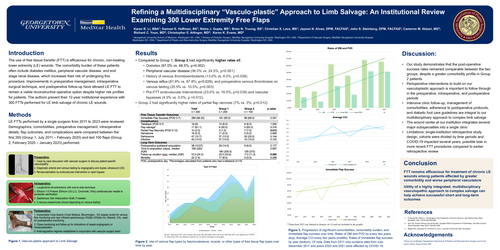
Refining a Multidisciplinary “Vasculo-plastic” Approach to Limb Salvage: An Institutional Review Examining 300 Lower Extremity Free Flaps
Introduction
The use of free tissue transfer (FTT) is efficacious for chronic, non-healing lower extremity (LE) wounds. The comorbidity burden of these patients often include diabetes mellitus, peripheral vascular disease, and end stage renal disease, which increases their risk of undergoing this procedure. Improvements in preoperative management, intraoperative surgical technique, and postoperative follow-up have allowed LE FTT to remain a viable reconstructive operative option despite higher risk profiles for patients. The authors present their 12-year institutional experience with 300 FTTs performed for LE limb salvage of chronic LE wounds.
Methods
LE FTTs performed by a single surgeon from 2011 to 2023 were reviewed. Demographics, comorbidities, preoperative management, intraoperative details, flap outcomes, and complications were compared between the first 200 (Group 1, July 2011 – February 2020) and last 100 flaps (Group 2, February 2020 – January 2023) performed.
Results
Discussion
Conclusion
FTT remains efficacious for treatment of chronic LE wounds among patients affected by greater comorbidity and worse peripheral vasculature. Utility of a highly integrated, multidisciplinary vasculopathic approach to complex salvage can help achieve successful short and long-term outcomes