Loading...

203 posters, 14 topics, 5 sessions, 817 authors, 256 institutions

ePostersLive by SciGen Technologies S.A. All rights reserved.

The AAPS 102nd Annual Meeting

May 18-21, 2024 | The Westin Copley Place, Boston, MA

The AAPS 102nd Annual Meeting banner

D117

Skin Graft Failure At The Time Of Muscle Free Tissue Transfer In The Comorbid Population Undergoing Limb Salvage Procedures
Part of Topic

Hand/Extremity

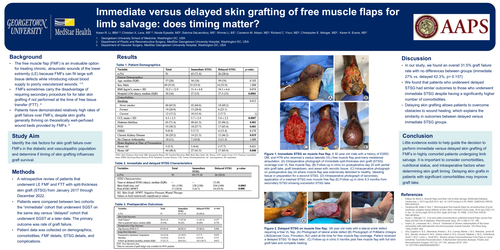
Immediate versus delayed skin grafting of free muscle flaps for limb salvage: does timing matter?

Background

•The free muscle flap (FMF) is an invaluable option for treating chronic, atraumatic wounds of the lower extremity (LE) because FMFs can fill large soft tissue defects while introducing robust blood supply to poorly vascularized wounds. 1-3
• FMFs sometimes carry the disadvantage of requiring secondary procedure for for later skin grafting if not performed at the time of free tissue transfer (FTT). 4
•Patients have demonstrated relatively high rates of graft failure over FMFs, despite skin grafts generally thriving on theoretically well-perfused wound beds provided by FMFs. 5
 

Study Aim

Identify the risk factors for skin graft failure over FMFs in the diabetic and vasculopathic population and determine if timing of skin grafting influences graft survival.

Methods

•A retrospective review of patients that underwent LE FMF and FTT with split-thickness skin graft (STSG) from January 2017 through December 2022.
•Patients were compared between two cohorts: the “immediate” cohort that underwent SGST on the same day versus “delayed” cohort that underwent SGST at a later date. The primary outcome was rate of graft failure.
•Patient data was collected on demographics, comorbidities, FMF details, STSG details, and complications.
 

Discussion 

•In our study, we found an overall 31.5% graft failure rate with no differences between groups (immediate 27% vs. delayed 42.3%, p= 0.157)  
•We found that patients who underwent delayed STSG had similar outcomes to those who underwent immediate STSG despite having a significantly higher number of comorbidities.
•Delaying skin grafting allows patients to overcome obstacles to wound healing, which explains the similarity in outcomes between delayed versus immediate STSG groups.
 

Conclusion

Little evidence exists to help guide the decision to perform immediate versus delayed skin grafting of FMFs in highly comorbid patients undergoing limb salvage. It is important to consider comorbidities, nutritional status, and intraoperative factors when determining skin graft timing. Delaying skin grafts in patients with significant comorbidities may improve graft take.

The AAPS 102nd Annual Meeting » banner
Copyright © 2015-2026, ePostersLive® SciGen is a registered trademark of SciGen Technologies S.A. Patent pending.

This website and third-party tools we use rely on cookies for the best user experience. By selecting "I agree", you agree to cookie usage as described in our Privacy Policy.