203 posters, 14 topics, 5 sessions, 817 authors, 256 institutions
ePostersLive by SciGen Technologies S.A. All rights reserved.
The AAPS 102nd Annual Meeting
May 18-21, 2024 | The Westin Copley Place, Boston, MA

D25
“Vasculoplastic” Approach To Limb Salvage In The Lower Extremity Free Flap Population With Chronic Wounds: Understanding Targeted Versus Non-targeted Endovascular Revascularization For Lower Extremity Free Tissue Transfer
Poster Presenter
Authors
Karen Li, Christian Lava, Nisha Gupta, Cecelia Hidalgo, Nicole Episalla, MD, Cameron Akbari, MD, Karen Evans, MD
Affiliations
Georgetown School of Medicine, Department of Plastic Surgery, Medstar Georgetown University Hospital, Department of Vascular Surgery, Medstar Georgetown University Hospital
Part of Topic
Hand/Extremity
Vasculoplastic” Approach To Atraumatic Limb Salvage: Understanding Targeted Versus Non-targeted Endovascular Revascularization For Lower Extremity Free Tissue Transfer
Introduction
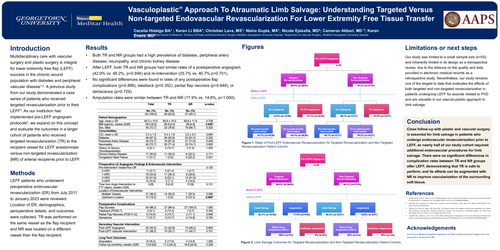
Multidisciplinary care with vascular surgery and plastic surgery is integral for lower extremity free flap (LEFF) success in the chronic wound population with diabetes and peripheral vascular disease1,2. A previous study from our study demonstrated a case series of patients who received targeted revascularization prior to their LEFF3. As our institution has implemented pre-LEFF angiogram protocols4, we expand on this concept and evaluate the outcomes in a larger cohort of patients who received targeted revascularization (TR) to the recipient vessel for LEFF anastomosis versus non-targeted revascularization (NR) of arterial recipients prior to LEFF.
Methods
LEFF patients who underwent preoperative endovascular revascularization (ER) from July 2011 to January 2023 were reviewed. Location of ER, demographics, perioperative details, and outcomes were collected. TR was performed on the same vessel as the flap recipient and NR was located on a different vessel than the flap recipient.
Results
Conclusion
Close follow-up with plastic and vascular surgery is essential for limb salvage in patients who undergo endovascular revascularization prior to LEFF, as nearly half of our study cohort required additional endovascular procedures for limb salvage. There were no significant differences in complication rates between TR and NR groups after LEFF, demonstrating that TR is safe to perform, and its effects can be augmented with NR to improve vascularization of the surrounding soft tissue.
Limitations or next steps
Our study was limited to a small sample size (n=55) and inherently limited in its design as a retrospective review, due to the reliance on the quality and data provided in electronic medical records as a retrospective study Nevertheless, our study remains one of the largest to date that evaluates the effects of both targeted and non-targeted revascularization in patients undergoing LEFF for wounds related to PVD and are valuable in our vasculo-plastic approach to limb salvage.