203 posters, 14 topics, 5 sessions, 817 authors, 256 institutions
ePostersLive by SciGen Technologies S.A. All rights reserved.
The AAPS 102nd Annual Meeting
May 18-21, 2024 | The Westin Copley Place, Boston, MA

D26
Routine Endoscopic Carpal Tunnel Release (ectr) At The Time Of Orif Of Distal Radius Fractures (drf) Reduces The Incidence Of Complex Regional Pain Syndrome (crps)
Poster Presenter
Authors
Affiliations
Part of Topic
Hand/Extremity
Complex regional pain syndrome (CRPS) is a devastating consequence of distal radius fracture (DRF) with a well-recognized incidence of 4-7%. Untreated peripheral nerve compression such as carpal tunnel syndrome (CTS) exacerbates and prolongs CRPS symptoms. In an effort to minimize CRPS, our practice routinely performs endoscopic carpal tunnel release on all DRF patients. In this study we evaluated the incidence of CRPS in a cohort of patients who underwent routine endoscopic carpal tunnel release (ECTR) at the time of DRF fixation so to compare it to historical rates.
We performed a single-center retrospective chart review of all patients surgically treated for DRF in our ambulatory surgery center between 2016-2022. Less than 3 month follow-up patients were excluded. Demographic characteristics, comorbidities, fracture characteristics, and therapy notes were reviewed. Multivariable analyses were performed to identify factors associated with CRPS following surgery.
We identified 685 patients (178 M; 507 F) with DRF treated electively with ECTR at the time of ORIF without obvious physical exam findings of acute CTS. Average age (61 +/-19), days presentation from injury (4 +/-4d), intra vs extra articular fracture pattern (76 vs. 24%), postoperative immobilization period (16 +/-7d) were calculated. Of these patients, .006% (4) were diagnosed with CRPS in their ipsilateral extremity within 3 months of sustaining the DRF. Multivariate analysis failed to identify any predictive variables in those patients that developed CRPS as
This retrospective review shows that the incidence of CRPS in this treatment group is 1000-fold lower than that routinely reported for DRF. Our series suggest that patients may benefit from ECTR concurrent to DRF ORIF.
Complex Regional Pain Syndrome (CRPS) is a chronic pain condition, usually affecting the distal extremities, following a noxious event. Inciting events may be a fracture, particularly of the distal radius, which has been associated with a CRPS incidence between 0.36[i] and 36.7%. [ii] Population-based epidemiological studies have reported the overall incidence rate of CRPS was 26.2 per 100,000 person-years in the Netherlands[iii], and 5.46 per 100,000 person-years in Olmsted County, Minnesota.[iv]
CRPS is a rare, poorly understood pain disorder characterized by pain out of proportion to the injury, edema, vasomotor instability, and stiffness. CRPS can be classified into type I and type II, of which type I, without a nerve lesion, is more common.[v] The diagnosis of CRPS is purely clinical, facilitated by the 2003 Budapest Criteria (Table 1), and excluding other conditions such as infection, compartment syndrome, peripheral vascular disease, deep vein thrombosis, peripheral neuropathy, rheumatoid arthritis, vascular outlet syndrome, Raynaud phenomenon, and erythromelalgia.
Surgical management of distal radius fractures has also been linked to the development of CRPS. With the advent of volar plates, open reduction and internal fixation (ORIF) has become the most common surgical treatment for unstable distal radius fractures (DRF).[vi] A recent study examining the incidence rate and risk factors for CRPS-1 in 172,194 DRFs treated surgically from 2007 to 2014 using the nationwide database of the Korean HIRA found the rate of CRPS following surgical management of DRF to be 0.64% in South Korea.[vii] This is in contrast to a smaller Korean study examining 477 patients with a surgically treated DRF, which identified 42 patients (8.8%) with CRPS within 6 months of surgery, with risk factors including female gender, comminuted fractures, and high-energy trauma.[viii]
A potential association between resolution of CRPS and carpal tunnel release (CTR) has been described. In small case series, Stein et al. (1961)[ix], Grundberg and Reagan (1991)[x], Jupiter et al. (1994)[xi], Placzek et al. (2005)[xii], and Koh et al. (2010)[xiii] have documented alleviation of CRPS symptoms and improvement of hand function following CTR.
In a recent large national database study, nearly 20% of patients who underwent a DRF ORIF required a CTR in a second surgery rather than at the time of ORIF. Female gender, age between 50-80 years, diabetes, hypothyroidism, smoking, and obesity were factors significantly associated with CTR following DRF..[xv]
We show, using retrospective data analysis, that prophylactic CTR during DRF plate results in a significantly reduced incidence of CRPS, in comparison to epidemiological data. These findings have immediate clinical translation and are important with respect to guiding clinical practice.
We performed a retrospective review of all patients presenting to a single hand surgery practice comprised of five surgeons. All distal radius fixation was performed via a volar approach using a modified Henry approach. All carpal tunnel releases were performed via an endoscopic technique using the MicroaAire Smart Release system which utilizes a single portal Agee technique.
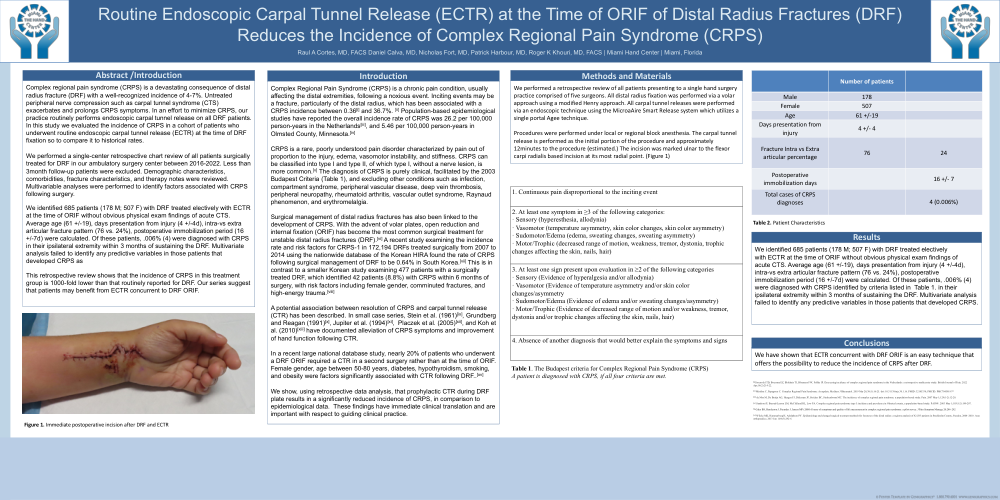
Procedures were performed under local or regional block anesthesia. The carpal tunnel release is performed as the initial portion of the procedure and approximately 12minutes to the procedure (estimated.) The incision was marked ulnar to the flexor carpi radialis based incision at its most radial point. (Figure 1)
We identified 685 patients (178 M; 507 F) with DRF treated electively with ECTR at the time of ORIF without obvious physical exam findings of acute CTS. Average age (61 +/-19), days presentation from injury (4 +/-4d), intra-vs extra articular fracture pattern (76 vs. 24%), postoperative immobilization period (16 +/-7d) were calculated. Of these patients, .006% (4) were diagnosed with CRPS identified by criteria listed in Table 1. in their ipsilateral extremity within 3 months of sustaining the DRF. Multivariate analysis failed to identify any predictive variables in those patients that developed CRPS.
We have shown that ECTR concurrent with DRF ORIF is an easy technique that offers the possibility to reduce the incidence of CRPS after DRF.