203 posters, 14 topics, 5 sessions, 817 authors, 256 institutions
ePostersLive by SciGen Technologies S.A. All rights reserved.
The AAPS 102nd Annual Meeting
May 18-21, 2024 | The Westin Copley Place, Boston, MA

P9
Combating The Learning Curve For DIEP Flaps: Preliminary Results From A Cognitive Task Analysis Study
Poster Presenter
Authors
Jacquelyn Knox, Aileen Gozali, Christiane How-Volkman, Serena Bhaskerrao, Daniel Soroudi, Adnan Alseidi, Bao-Quynh Julian, Arash Momeni, Maura Sullivan, Merisa Piper
Affiliations
University of California, San Francisco, Stanford University, California Northstate University, University of Southern California
Part of Topic
Aesthetic Face/Breast/Body/ Body Contouring
Background
• As with all microsurgical procedures, DIEP (deep inferior epigastric artery
perforator) flaps have steep learning curves.
• As novice surgeons à experts, re-exploration rates and OR times ↓
• What cognitive + technical processes differ between novice and expert?
• Cognitive Task Analysis (CTA) deconstructs procedures à discrete tasks
and makes explicit the implicit behaviors + cognitive processes of experts.
Aims
To combat the learning curve for DIEP flaps through CTA by:
1. Defining the tasks, decisions, and potential errors in a DIEP flap.
2. Unveiling the expert cognitive behaviors required for success
Methods
• Cognitive Task Analysis
Preliminary coding + analysis based on cognitive behavior framework by
Grover for Roux-en-Y gastric bypass (Grover et. al., Surg Endoscopy, 2023)
Results
Expert Characteristics
• Microsurgery fellowship-trained
• Works in high volume breast cancer center
• Performed > 400 DIEP flaps
Results – Major Tasks and Subtasks
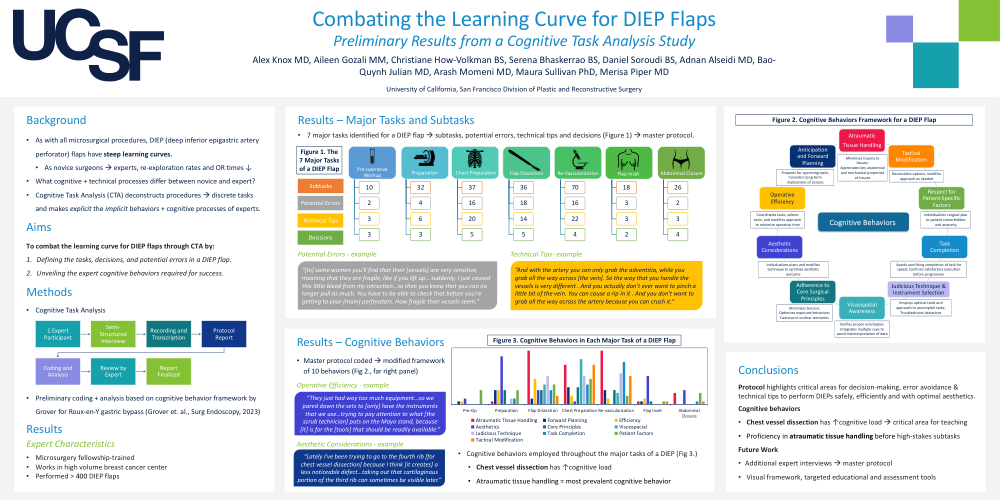
• 7 major tasks identified for a DIEP flap à subtasks, potential errors, technical tips and decisions (Figure 1) à master protocol
Potential Errors - example
“[In] some women you'll find that their [vessels] are very sensitive,
meaning that they are fragile, like if you lift up… suddenly, I just caused
this little bleed from my retraction…so then you know that you can no
longer pull as much. You have to be able to check that before you're
getting to your [main] perforators. How fragile their vessels seem.”
Technical Tips- example
“And with the artery you can only grab the adventitia, while you
grab all the way across [the vein]. So the way that you handle the
vessels is very different . And you actually don’t ever want to pinch a
little bit of the vein. You can cause a rip in it . And you don't want to
grab all the way across the artery because you can crush it.”
Results – Cognitive Behaviors
• Master protocol coded à modified framework
of 10 behaviors (Fig 2, right)
Operative Efficiency - example
“They just had way too much equipment…so we
paired down the sets to [only] have the instruments
that we use…trying to pay attention to what [the
scrub technician] puts on the Mayo stand, because
[it] is for the [tools] that should be readily available.”
Aesthetic Considerations - example
“Lately I've been trying to go to the fourth rib [for
chest vessel dissection] because I think [it creates] a
less noticeable defect…taking out that cartilaginous
portion of the third rib can sometimes be visible later.”
Cognitive behaviors employed throughout the major tasks of a DIEP (Fig 3.)
• Chest vessel dissection has ↑cognitive load
• Atraumatic tissue handling = most prevalent cognitive behavior
Conclusions
Protocol highlights critical areas for decision-making, error avoidance &
technical tips to perform DIEPs safely, efficiently and with optimal aesthetics.
Cognitive behaviors
• Chest vessel dissection has ↑cognitive load à critical area for teaching
• Proficiency in atraumatic tissue handling before high-stakes subtasks
Future Work
• Additional expert interviews à master protocol
• Visual framework, targeted educational and assessment tools