203 posters, 14 topics, 5 sessions, 817 authors, 256 institutions
ePostersLive by SciGen Technologies S.A. All rights reserved.
The AAPS 102nd Annual Meeting
May 18-21, 2024 | The Westin Copley Place, Boston, MA

D1
Same Versus Different Projection Implants In Asymmetric Tuberous Breasts: Analysis Long-term Outcome And Patient’s Satisfaction
Poster Presenter
Part of Topic
Aesthetic Face/Breast/Body/ Body Contouring
Introduction: The approach to addressing tuberous breast deformity has evolved significantly, with a wide array of procedures now available. Yet, ensuring a durable and natural breast shape remains a persistent challenge. Implant-based correction emerges as one of the most effective methods for addressing this condition. However, a primary challenge frequently encountered by plastic surgeons is managing asymmetries. The aim of this study is to analyze the outcomes using same or different projection implants in patients with asymmetry grade A or B and tuberous breast grade I, II or III.
Methods: Eligible patients met the following criteria: Primary surgical procedure for correction of tuberous malformation; Follow up for almost 2 years; standard pre and postoperative photo-documentation; proficiency in Italian language; and signed consent for study participation. All procedures were performed by the same surgical team, using a singular or double superior glandular flap for the correction of the tuberous breast, using retroglandular round implants and circumareolar incision. The Italian version of the BREAST-Q was administered to all patients, approximately 2 years postoperatively. We compared levels of patient satisfaction with the breast postoperative module by group, using the Chi-squared test for unpaired data. Two plastic surgeons reviewed all postoperative photographs of treated patients and rated outcomes on a VAS scale of 1–5.
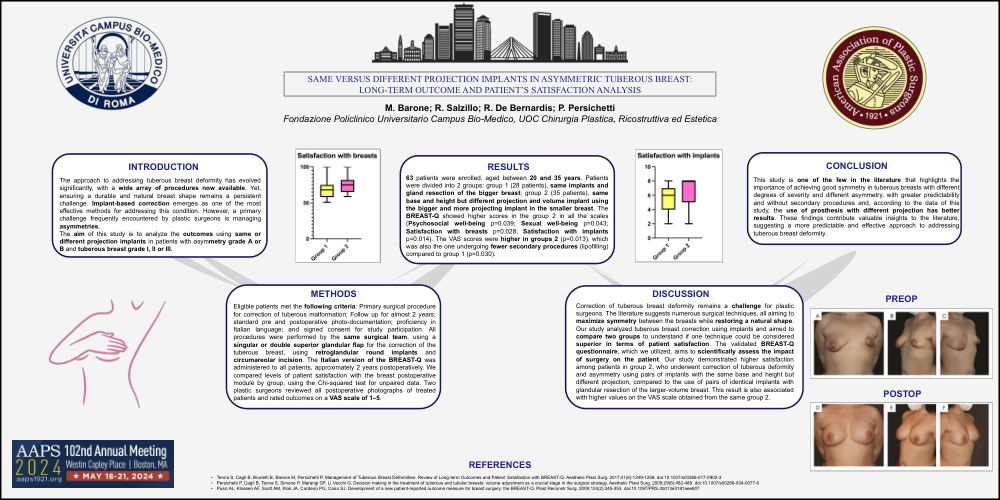
Results: 63 patients were enrolled, aged between 20 and 35 years. Patients were divided into 2 groups: group 1 (28 patients), same implants and gland resection of the bigger breast; group 2 (35 patients), same base and height but different projection and volume implant using the bigger and more projecting implant in the smaller breast. The BREAST-Q showed higher scores in the group 2 in all the scales (Psychosocial well-being p=0.039; Sexual well-being p=0.043; Satisfaction with breasts p=0.028; Satisfaction with implants p=0.014). The VAS scores were higher in groups 2 (p=0.013), which was also the one undergoing fewer secondary procedures (lipofilling) compared to group 1 (p=0.030).
Discussion: Correction of tuberous breast deformity remains a challenge for plastic surgeons. The literature suggests numerous surgical techniques, all aiming to maximize symmetry between the breasts while restoring a natural shape. Our study analyzed tuberous breast correction using implants and aimed to compare two groups to understand if one technique could be considered superior in terms of patient satisfaction. The validated BREAST-Q questionnaire, which we utilized, aims to scientifically assess the impact of surgery on the patient. Our study demonstrated higher satisfaction among patients in group 2, who underwent correction of tuberous deformity and asymmetry using pairs of implants with the same base and height but different projection, compared to the use of pairs of identical implants with glandular resection of the larger-volume breast. This result is also associated with higher values on the VAS scale obtained from the same group 2.
Conclusion: This study is one of the few in the literature that highlights the importance of achieving good symmetry in tuberous breasts with different degrees of severity and different asymmetry, with greater predictability and without secondary procedures and, according to the data of this study, the use of prosthesis with different projection has better results. These findings contribute valuable insights to the literature, suggesting a more predictable and effective approach to addressing tuberous breast deformity.