203 posters, 14 topics, 5 sessions, 817 authors, 256 institutions
ePostersLive by SciGen Technologies S.A. All rights reserved.
The AAPS 102nd Annual Meeting
May 18-21, 2024 | The Westin Copley Place, Boston, MA

P12
Alpha Defensin-1 Level Correlates With Peri-prosthetic Infection Severity Following Implant-based Breast Reconstruction
Poster Presenter
Part of Topic
Aesthetic Face/Breast/Body/ Body Contouring
Alpha Defensin-1 Level Correlates with Peri-Prosthetic Infection Severity following Implant-Based Breast Reconstruction
Introduction
•Alpha-defensin-1 (AD-1) is an antimicrobial peptide released by neutrophils in response to active infection.
•Proven to be both sensitive and specific for the identification breast implant infection (qualitative).
•Quantitative analysis of AD-1 as a measure of infection severity remains lacking.
•Hypothesis: levels of AD-1 within peri-implant fluid samples correlate with degree of infection.
Methods
•Prospectively maintained database
(n = 29 patients; 38 breasts).
•Peri-prosthetic fluid was sampled, and AD-1 levels were sent for quantitative analysis.
•Control samples obtained during exchange or revision procedures.
•Modified Spear score for infection severity:
Statistical Analysis:
•Descriptive statistics of patient and management characteristics.
•Evaluation of relationship between AD-1 level and systemic signs of infection.
•Ordinal logistic regression performed to evaluate the correlation between infection severity and AD-1 level.
Results
•Total of 15 infected breasts (23 non-infected).
•Groups well-matched, except plane of reconstruction (DTI → ↑ infection rate, p < 0.01).
•Mean AD-1 Levels (>1 suggests infection):
•Infected = 3.97 (2.66-5.61)
•Non-Infected = 0.12 (0.08-0.16)
•Per unit increase in AD-1 correlated with clinical signs of infection.
•Clinical examination (i.e., erythema) less reliable:
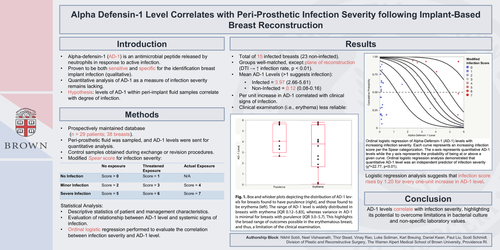
Logistic regression analysis suggests that infection score rises by 1.20 for every one-unit increase in AD-1 level.
Conclusion
AD-1 levels correlate with infection severity, highlighting its potential to overcome limitations in bacterial culture and non-specific laboratory values.