203 posters, 14 topics, 5 sessions, 817 authors, 256 institutions
ePostersLive by SciGen Technologies S.A. All rights reserved.
The AAPS 102nd Annual Meeting
May 18-21, 2024 | The Westin Copley Place, Boston, MA

D23
A Wearable Wireless Device Monitors Sacral Pressure During Operative Cases
Poster Presenter
Part of Topic
Education/Practice Management/Other
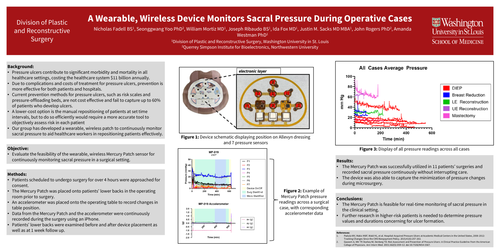
Background: • Pressure ulcers contribute to significant morbidity and mortality in all healthcare settings, costing the healthcare system $11 billion annually. • Due to complications and costs of treatment for pressure ulcers, prevention is more effective for both patients and hospitals. • Current prevention methods for pressure ulcers, such as risk scales and pressure-offloading beds, are not cost effective and fail to capture up to 60% of patients who develop ulcers. • A lower-cost option is the manual repositioning of patients at set time intervals, but to do so efficiently would require a more accurate tool to objectively assess risk in each patient • Our group has developed a wearable, wireless patch to continuously monitor sacral pressure to aid healthcare workers in repositioning patients effectively.
Objective: • Evaluate the feasibility of the wearable, wireless Mercury Patch sensor for continuously monitoring sacral pressure in a surgical setting
Methods: • Patients scheduled to undergo surgery for over 4 hours were approached for consent. • The Mercury Patch was placed onto patients’ lower backs in the operating room prior to surgery. • An accelerometer was placed onto the operating table to record changes in table position. • Data from the Mercury Patch and the accelerometer were continuously recorded during the surgery using an iPhone. • Patients’ lower backs were examined before and after device placement as well as at 1 week follow up.
Results: • The Mercury Patch was successfully utilized in 11 patients’ surgeries and recorded sacral pressure continuously without interrupting care. • The device was also able to capture the minimization of pressure changes during microsurgery.
Conclusions: • The Mercury Patch is feasible for real-time monitoring of sacral pressure in the clinical setting. • Further research in higher-risk patients is needed to determine pressure values and durations concerning for ulcer formation.