203 posters, 14 topics, 5 sessions, 817 authors, 256 institutions
ePostersLive by SciGen Technologies S.A. All rights reserved.
The AAPS 102nd Annual Meeting
May 18-21, 2024 | The Westin Copley Place, Boston, MA

D105
Anatomical Training And Legacies Of Abuse In Surgery (A.T.L.A.S.): Surgeons' Ethical Decisionmaking Around Problematic Resources In Surgery And Surgical Education
Poster Presenter
Part of Topic
Education/Practice Management/Other
INTRODUCTION
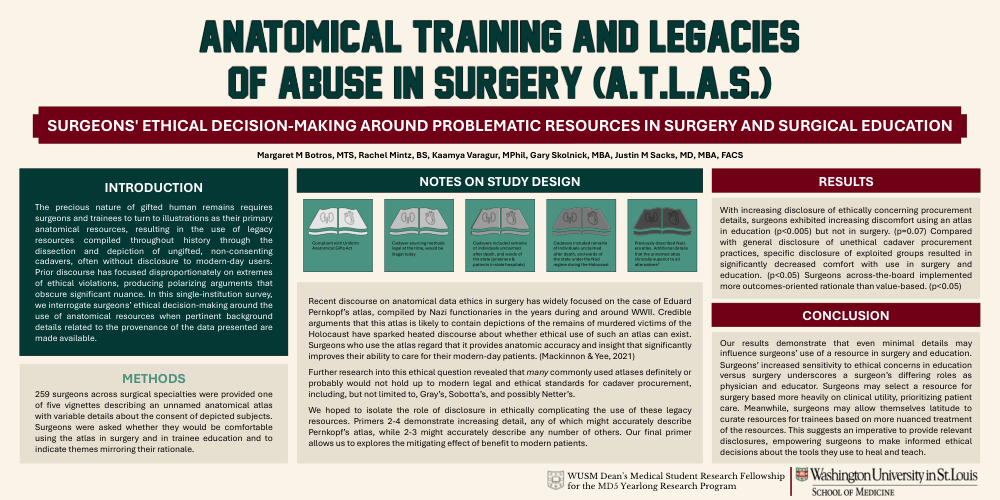
The precious nature of gifted human remains requires surgeons and trainees to turn to illustrations as their primary anatomical resources, resulting in the use of legacy resources compiled throughout history through the dissection and depiction of ungifted, non-consenting cadavers, often without disclosure to modern-day users. Prior discourse has focused disproportionately on extremes of ethical violations, producing polarizing arguments that obscure significant nuance. In this single-institution survey, we interrogate surgeons’ ethical decision-making around the use of anatomical resources when pertinent background details related to the provenance of the data presented are made available.
METHODS
259 surgeons across surgical specialties were provided one of five vignettes describing an unnamed anatomical atlas with variable details about the consent of depicted subjects. Surgeons were asked whether they would be comfortable using the atlas in surgery and in trainee education and to indicate themes mirroring their rationale.
NOTES ON STUDY DESIGN
Recent discourse on anatomical data ethics in surgery has widely focused on the case of Eduard Pernkopf’s atlas, compiled by Nazi functionaries in the years during and around WWII. Credible arguments that this atlas is likely to contain depictions of the remains of murdered victims of the Holocaust have sparked heated discourse about whether ethical use of such an atlas can exist. Surgeons who use the atlas regard that it provides anatomic accuracy and insight that significantly improves their ability to care for their modern-day patients. (Mackinnon & Yee, 2021) Further research into this ethical question revealed that many commonly used atlases definitely or probably would not hold up to modern legal and ethical standards for cadaver procurement, including, but not limited to, Gray’s, Sobotta’s, and possibly Netter’s.
We hoped to isolate the role of disclosure in ethically complicating the use of these legacy resources. Primers 2-4 demonstrate increasing detail, any of which might accurately describe Pernkopf’s atlas, while 2-3 mightaccurately describe any number of others. Our final primer allows us to explores the mitigating effect of benefit to modern patients.
RESULTS
With increasing disclosure of ethically concerning procurement details, surgeons exhibited increasing discomfort using an atlas in education (p<0.005) but not in surgery. (p=0.07) Compared with general disclosure of unethical cadaver procurement practices, specific disclosure of exploited groups resulted in significantly decreased comfort with use in surgery and education. (p<0.05) Surgeons across-the-board implemented more outcomes-oriented rationale than value-based. (p<0.05)
CONCLUSION
Our results demonstrate that even minimal details may influence surgeons’ use of a resource in surgery and education. Surgeons’ increased sensitivity to ethical concerns in education versus surgery underscores a surgeon’s differing roles as physician and educator. Surgeons may select a resource for surgery based more heavily on clinical utility, prioritizing patient care. Meanwhile, surgeons may allow themselves latitude to curate resources for trainees based on more nuanced treatment of the resources. This suggests an imperative to provide relevant disclosures, empowering surgeons to make informed ethical decisions about the tools they use to heal and teach.