203 posters, 14 topics, 5 sessions, 817 authors, 256 institutions
ePostersLive by SciGen Technologies S.A. All rights reserved.
The AAPS 102nd Annual Meeting
May 18-21, 2024 | The Westin Copley Place, Boston, MA

D132
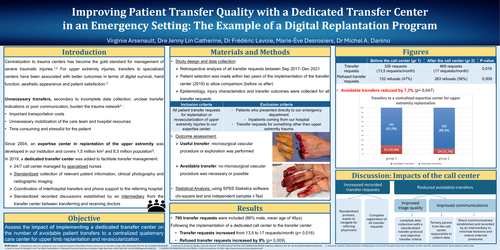
Improving Patient Transfer Quality With A Dedicated Transfer Center In An Emergency Setting: The Example Of A Digital Replantation Program
Poster Presenter
Authors
Virginie Arsenault, Jenny C. Lin, Frédéric Lavoie, Marie-Ève Desrosiers, Michel A. Danino
Affiliations
University of Montreal, Department of Plastic and Reconstructive Surgery, Centre Hospitalier de l’Université de Montréal (CHUM), Department of Orthopedic Surgery, Centre Hospitalier de l’Université de Montréal (CHUM), Centre Hospitalier de l'Université de Montréal (CHUM)
Part of Topic
Education/Practice Management/Other
Improving Patient Transfer Quality with a Dedicated Transfer Center in an Emergency Setting: The Example of a Digital Replantation Program
Introduction
Centralization to trauma centers has become the gold standard for management of severe traumatic injuries.1,2 For upper extremity injuries, transfers to specialized centers have been associated with better outcomes in terms of digital survival, hand function, aesthetic appearance and patient satisfaction.3
Unnecessary transfers, secondary to incomplete data collection, unclear transfer indications or poor communication, burden the trauma network4 :
Since 2004, an expertise center in replantation of the upper extremity was developed in our institution and covers 1,5 million km2 and 8,5 million population5.
In 2019, a dedicated transfer center was added to facilitate transfer management:
Assess the impact of implementing a dedicated transfer center on the number of avoidable patient transfers to a centralized quaternary care center for upper limb replantation and revascularization.
Materials and Methods
chi-square test and independent samples t-Test
Following the implementation of a dedicated call center to the transfer center: