203 posters, 14 topics, 5 sessions, 817 authors, 256 institutions
ePostersLive by SciGen Technologies S.A. All rights reserved.
The AAPS 102nd Annual Meeting
May 18-21, 2024 | The Westin Copley Place, Boston, MA

P6
Local Breast Microbiome In Tissue Expander Reconstruction And Change Over Time With Antibiotics
Poster Presenter
Part of Topic
Aesthetic Face/Breast/Body/ Body Contouring
Local Breast Microbiome in Tissue Expander Reconstruction and Change Over Time with Antibiotics
Laura Barnes, MD; Nisha Parmeshwar, MD; Jacquelyn Knox, MD; Aileen Gozali, BS; Catherine Dugan, BS; Anne Patterson, BS; Merisa Piper, MD
Purpose:
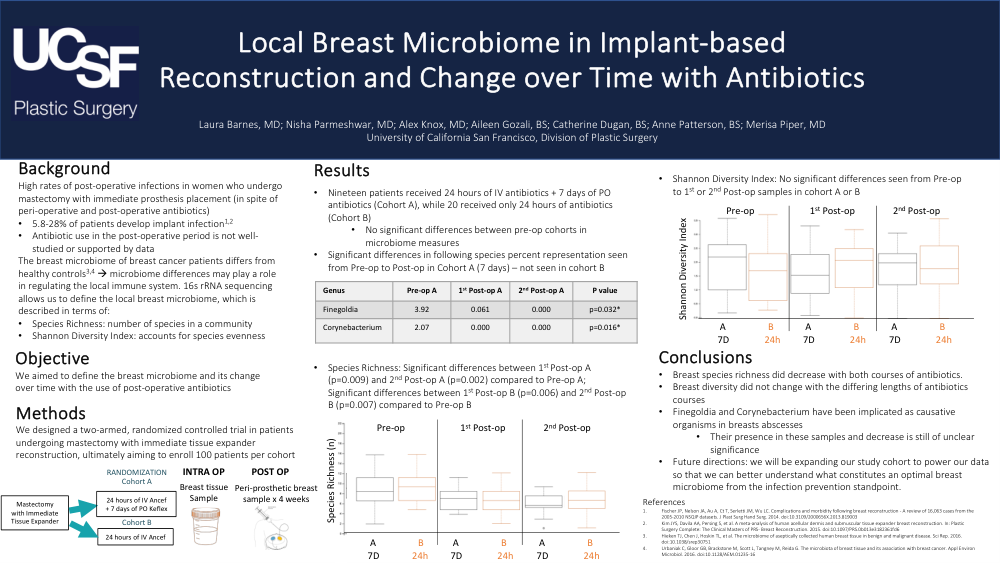
16S rRNA microbiome sequencing allows us to define a local breast microbiome. Peri-expander fluid can be readily collected in patients with a dual port tissue expander, allowing us to define the local microbiome at any given time point. We aimed to define the breast microbiome and it’s change over time with the use of post-operative antibiotics.
Methods:
We designed a two-armed randomized-controlled trial in patients undergoing mastectomy with immediate tissue expander reconstruction. Patients were randomized to either receive only 24 hours of peri-operative antibiotics or an additional 7 days of post-operative antibiotics. We sampled and sequenced the breast microbiome using intra-operative breast tissue and two post-operative aspirate samples in all patients.
Results:
Twenty patients received 24 hours of antibiotics, while 19 received 7 days of antibiotics. Significant decreases were seen for species richness of Finegoldia and Corynebacterium species in the 7 day cohort comparing pre-op samples to post-op samples. This was not seen in the 24 hour cohort. There were no significant differences in overall microbiome diversity (Shannon index) from pre-op to post op samples for either cohort.
Conclusion:
Rather than focusing on eliminating certain bacteria with antibiotics, it may be more impactful to optimize the balance of the breast microbiome. Overall, breast diversity did not change with the different length course of antibiotics. Breast species richness did decrease with prolonged antibiotics. Finegoldia and corynebacterium have been implicated as causative organisms in breast abscesses. Its small presence in these samples and decrease is still of unclear significance.