Loading...

203 posters, 14 topics, 5 sessions, 817 authors, 256 institutions

ePostersLive by SciGen Technologies S.A. All rights reserved.

The AAPS 102nd Annual Meeting

May 18-21, 2024 | The Westin Copley Place, Boston, MA

The AAPS 102nd Annual Meeting banner

P27

Hydromechanical Therapy Improves Cutaneous Wound Healing Through Tissue Regeneration And Bioburden Reduction
Part of Topic

Innovations/Basic Science/Education & Practice Management

Hydromechanical Therapy Improves Cutaneous Wound Healing Through Tissue Regeneration and Bioburden Reduction

Helen S. Quinn, MD, Quynh Ahn Phan, BS, Bin Chen, MD, PhD, and Lifei Guo, MD, PhD

Background:
•Chronic wounds are difficult to treat, costly, and pose a significant burden on quality of life.
•Many therapy options exist including:
•Basic dry debriding dressings, novel dressings, platelet or stem cell therapy, negative pressure wound vacuums, hyperbaric oxygen therapy, and low-level laser therapy.
•Mechanical stress may promote angiogenesis, oxygen delivery, fibroblast differentiation, and cell division and hypertrophy.
•Bacterial biofilms produce proteases and disrupt host immune cell function, contributing to delayed wound healing.
 
Objective:
To evaluate the effect of hydromechanical therapy on wound healing and bacterial burden in a porcine model
 
Methods:
•10 full thickness square wounds were created on Guizhou pigs and infected with Pseudomonas aeruginosa.
•Day 2:
WaterPik: Irrigation therapy at 25 psi for 2 minutes
Control: Dry dressing changes twice daily
•Wound size, bacterial burden, gene transcriptions, and biofilm formation were measured and evaluated.
 
Results:
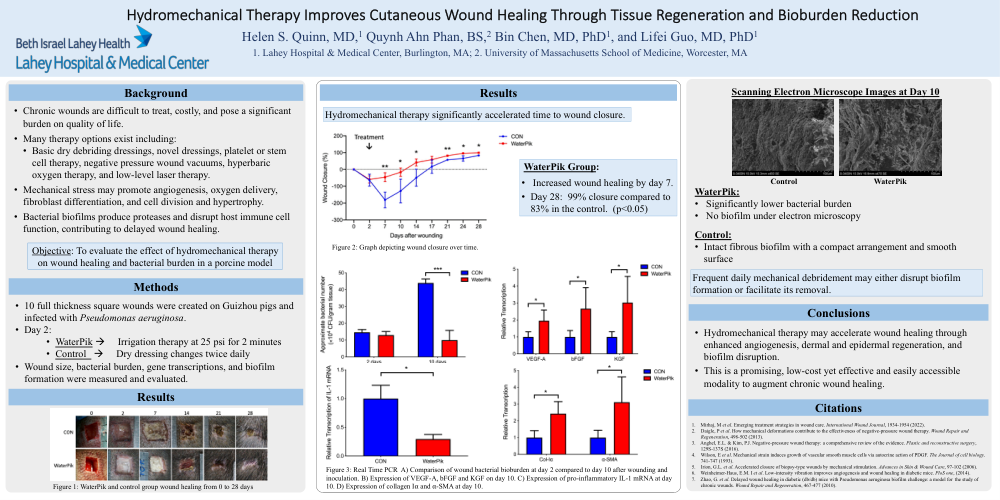
Hydromechanical therapy significantly accelerated time to wound closure.
WaterPik:
•Significantly lower bacterial burden
•No biofilm under electron microscopy
Control:
•Intact fibrous biofilm with a compact arrangement and smooth surface

Frequent daily mechanical debridement may either disrupt biofilm formation or facilitate its removal.

Conclusion:

•Hydromechanical therapy may accelerate wound healing through enhanced angiogenesis, dermal and epidermal regeneration, and biofilm disruption.

•This is a promising, low-cost yet effective and easily accessible modality to augment chronic wound healing.

The AAPS 102nd Annual Meeting » banner
Copyright © 2015-2026, ePostersLive® SciGen is a registered trademark of SciGen Technologies S.A. Patent pending.

This website and third-party tools we use rely on cookies for the best user experience. By selecting "I agree", you agree to cookie usage as described in our Privacy Policy.