203 posters, 14 topics, 5 sessions, 817 authors, 256 institutions
ePostersLive by SciGen Technologies S.A. All rights reserved.
The AAPS 102nd Annual Meeting
May 18-21, 2024 | The Westin Copley Place, Boston, MA

P19
Intimate Partner Violence Among Plastic Surgery Patients: A Single Institution Experience At Two Major Trauma Centers
Poster Presenter
Authors
Affiliations
Part of Topic
Innovations/Basic Science/Education & Practice Management
INTIMATE PARTNER VIOLENCE AMONG PLASTIC SURGERY PATIENTS: A SINGLE INSTITUTION EXPERIENCE AT TWO MAJOR TRAUMA CENTERS
Olivia Abbate Ford MD1, Daniel Koh BA2, Bharti Khurana MD3, Dennis Orgill MD, PhD1
INTRODUCTION
Intimate partner violence (IPV) is prevalent among trauma patients requiring the consultation of Plastic and Reconstructive Surgery1. The face and upper extremity are the most common areas of injury2,3. While plastic surgery is at the forefront of these disciplines, the prevalence of IPV in plastic surgery has yet to be described. The aim of this study is twofold:
1.
To investigate the quantity and quality of IPV injuries in patients treated by plastic and reconstructive surgery in our institutional trauma population.
2.
To assess residency awareness and competency with IPV injuries as it pertains to plastic surgery training.
METHODS
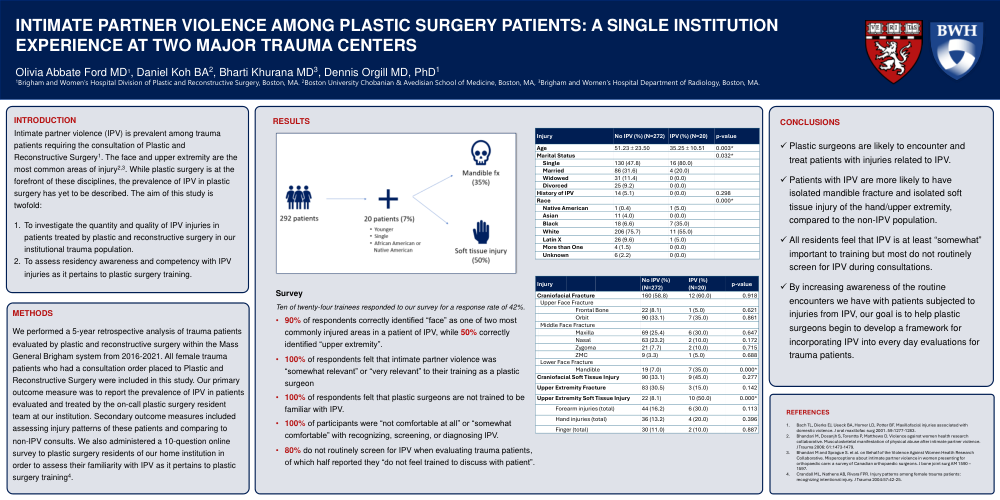
We performed a 5-year retrospective analysis of trauma patients evaluated by plastic and reconstructive surgery within the Mass General Brigham system from 2016-2021. All female trauma patients who had a consultation order placed to Plastic and Reconstructive Surgery were included in this study. Our primary outcome measure was to report the prevalence of IPV in patients evaluated and treated by the on-call plastic surgery resident team at our institution. Secondary outcome measures included assessing injury patterns of these patients and comparing to non-IPV consults. We also administered a 10-question online survey to plastic surgery residents of our home institution in order to assess their familiarity with IPV as it pertains to plastic surgery training4.
.
CONCLUSIONS
✓
Plastic surgeons are likely to encounter and treat patients with injuries related to IPV.
✓
Patients with IPV are more likely to have isolated mandible fracture and isolated soft tissue injury of the hand/upper extremity, compared to the non-IPV population.
✓
All residents feel that IPV is at least “somewhat” important to training but most do not routinely screen for IPV during consultations.
✓
By increasing awareness of the routine encounters we have with patients subjected to injuries from IPV, our goal is to help plastic surgeons begin to develop a framework for incorporating IPV into every day evaluations for trauma patients.