203 posters, 14 topics, 5 sessions, 817 authors, 256 institutions
ePostersLive by SciGen Technologies S.A. All rights reserved.
The AAPS 102nd Annual Meeting
May 18-21, 2024 | The Westin Copley Place, Boston, MA

P17
Enhancing Medical Student Education Through Gamified Immersive Virtual Reality: An Assessment Of Carpal Anatomy Learning
Poster Presenter
Part of Topic
Innovations/Basic Science/Education & Practice Management
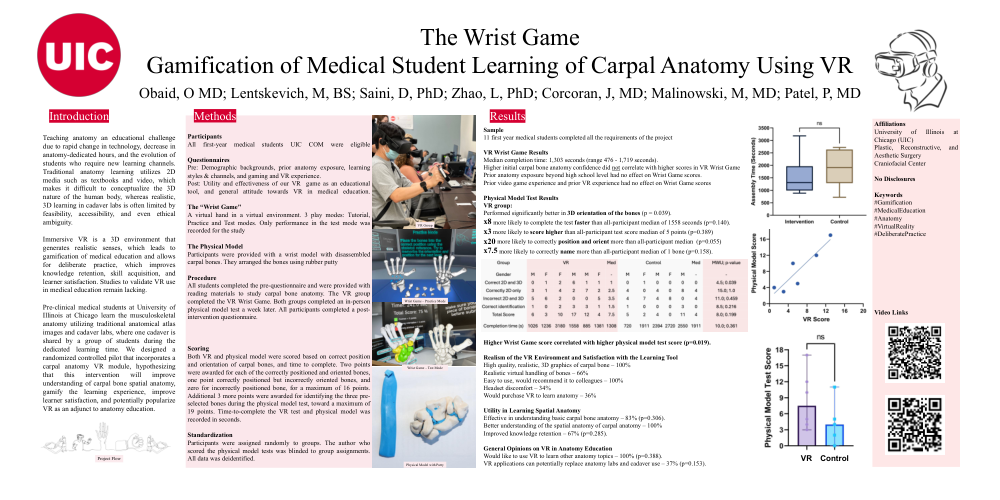
The Wrist Game
Medical Student Learning of Carpal Anatomy Using VR
Obaid, O MD; Lentskevich, M, BS; Saini, D, PhD; Zhao, L, PhD; Corcoran, J, MD; Malinowski, M, MD; Patel, P, MD
Introduction
Teaching anatomy an educational challenge due to rapid change in technology, decrease in anatomy-dedicated hours, and the evolution of students who require new learning channels. Traditional anatomy learning utilizes 2D media such as textbooks and video, which makes it difficult to conceptualize the 3D nature of the human body, whereas realistic, 3D learning in cadaver labs is often limited by feasibility, accessibility, and even ethical ambiguity.
Immersive VR is a 3D environment that generates realistic senses, which leads to gamification of medical education and allows for deliberate practice, which improves knowledge retention, skill acquisition, and learner satisfaction. Studies to validate VR use in medical education remain lacking.
Pre-clinical medical students at University of Illinois at Chicago learn the musculoskeletal anatomy utilizing traditional anatomical atlas images and cadaver labs, where one cadaver is shared by a group of students during the dedicated learning time. We designed a randomized controlled pilot that incorporates a carpal anatomy VR module, hypothesizing that this intervention will improve understanding of carpal bone spatial anatomy, gamify the learning experience, improve learner satisfaction, and potentially popularize VR as an adjunct to anatomy education.
Methods
Participants
All first-year medical students UIC COM were eligible
Questionnaires
Pre: Demographic backgrounds, prior anatomy exposure, learning styles & channels, and gaming and VR experience.
Post: Utility and effectiveness of our VR game as an educational tool, and general attitude towards VR in medical education.
The “Wrist Game"
A virtual hand in a virtual environment. 3 play modes: Tutorial, Practice and Test modes. Only performance in the test mode was recorded for the study
The Physical Model
Participants were provided with a wrist model with disassembled carpal bones. They arranged the bones using rubber putty
Procedure
All students completed the pre-questionnaire and were provided with reading materials to study carpal bone anatomy. The VR group completed the VR Wrist Game. Both groups completed an in-person physical model test a week later. All participants completed a post-intervention questionnaire.
Scoring
Both VR and physical model were scored based oncorrect position and orientation of carpal bones, and time to complete. Two points were awarded for each of the correctly positioned and oriented bones, one point correctly positioned but incorrectly oriented bones, and zero for incorrectly positioned bone, for a maximum of 16 points. Additional 3 more points were awarded for identifying the three pre-selected bones during the physical model test, toward a maximum of 19 points. Time-to-complete the VR test and physical model was recorded in seconds.
Standardization
Participants were assigned randomly to groups. The author who scored the physical model tests was blinded to group assignments. All data was deidentified.
Results
Sample
11 first year medical students completed all the requirements of the project
VR Wrist Game Results
Median completion time: 1,303 seconds (range 476 - 1,719 seconds).
Higher initial carpal bone anatomy confidence did notcorrelate with higher scores in VR Wrist Game
Prior anatomy exposure beyond high school level had no effect on Wrist Game scores.
Prior video game experience and prior VR experience had no effect on Wrist Game scores
Physical Model Test Results
VR group:
Performed significantly better in 3D orientation of the bones (p = 0.039).
x8 more likely to complete the test faster than all-participant median of 1558 seconds (p=0.140).
x3 more likely to score higher than all-participant test score median of 5 points (p=0.389)
x20 more likely to correctly position and orient more than all-participant median (p=0.055)
x7.5 more likely to correctly name more than all-participant median of 1 bone (p=0.158).
Higher Wrist Game score correlated with higher physical model test score (p=0.019).
Realism of the VR Environment and Satisfaction with the Learning Tool
High quality, realistic, 3D graphics of carpal bone – 100%
Realistic virtual handling of bones – 66%
Easy to use, would recommend it to colleagues – 100%
Headset discomfort – 34%
Would purchase VR to learn anatomy – 36%
Utility in Learning Spatial Anatomy
Effective in understanding basic carpal bone anatomy – 83% (p=0.306).
Better understanding of the spatial anatomy of carpal anatomy – 100%
Improved knowledge retention – 67% (p=0.285).
General Opinions on VR in Anatomy Education
Would like to use VR to learn other anatomy topics – 100% (p=0.388).
VR applications can potentially replace anatomy labs and cadaver use – 37% (p=0.153).
Affiliations
University of Illinois at Chicago (UIC)
Plastic, Reconstructive, and Aesthetic Surgery
Craniofacial Center
No Disclosures
Keywords
#Gamification
#MedicalEducation
#Anatomy
#VirtualReality
#DeliberatePractice
Video Links