203 posters, 14 topics, 5 sessions, 817 authors, 256 institutions
ePostersLive by SciGen Technologies S.A. All rights reserved.
The AAPS 102nd Annual Meeting
May 18-21, 2024 | The Westin Copley Place, Boston, MA

P18
Development And Comparative Evaluation Of Computer-based Assessment Tools For Manual And Robotic Microsurgery
Poster Presenter
Authors
Viola A. Stögner, Kai J. Wessel, Catherine T. Yu, Sam Boroumand, Xiny Xie, Hannah Ji, Alex Shi, Alex Wong, Lioba Huelsboemer, Bohdan Pomahac, Tobias Hirsch, Maximilian Kueckelhaus, Haripriya S. Ayyala
Affiliations
Yale School of Medicine, Department of Surgery, Division of Plastic and Reconstructive Surgery, Yale New Haven Hospital, Yale School of Medicine, New Haven, CT, USA, Department of Plastic and Reconstructive Surgery, Institute of Musculoskeletal Medicine, University Hospital Muenster, Germany, Yale Vision Lab, Department of Computer Science, Yale University, New Haven, CT, USA
Part of Topic
Innovations/Basic Science/Education & Practice Management
Development and Comparative Evaluation of Computer-based Assessment Tools for Manual and Robotic Microsurgery
Viola A. Stögner, MD1, Kai J. Wessel, MD2, Catherine T. Yu, BS1, Sam Boroumand, BS1, Xiny Xie3, Hannah Ji3, Alex Shi3, Alex Wong, PhD3, Lioba Huelsboemer MD1, Bohdan Pomahac, MD1, Tobias Hirsch, MD2, Maximilian Kueckelhaus, MD2, Haripriya S. Ayyala, MD1
1Department of Surgery, Division of Plastic and Reconstructive Surgery, Yale New Haven Hospital, Yale School of Medicine, New Haven, CT, USA
2 Department of Plastic and Reconstructive Surgery, Institute of Musculoskeletal Medicine, University Hospital Muenster, Germany
3Yale Vision Lab, Department of Computer Science, Yale University, New Haven, CT, USA
Background
Microsurgical evaluations are invaluable
for microsurgical skill development,
however, time- and personnel demanding.
The concept of robotic-assisted
microsurgery raises microsurgical training
requirements of un-/experienced
microsurgeons to a new level. This study
aimed to develop efficient and reliable
tools for microsurgical self-assessment,
applicable to both conventional and
robotic-assisted microsurgery.
Material & Methods
Development of two deep convolutional
neural network-based computer
algorithms:
1. Microsurgical instrument tracking
video analysis
supervised and semi-supervised
learning used to train models
2. Anastomosis quality assessment
trained computer algorithm
analysis of everted anastomosis
images
Total training images: 90 manual
and 90 robotic anastomoses (1.0
mm Ø silicone vessels (WetLab,
Japan); 10-0 sutures)
Results
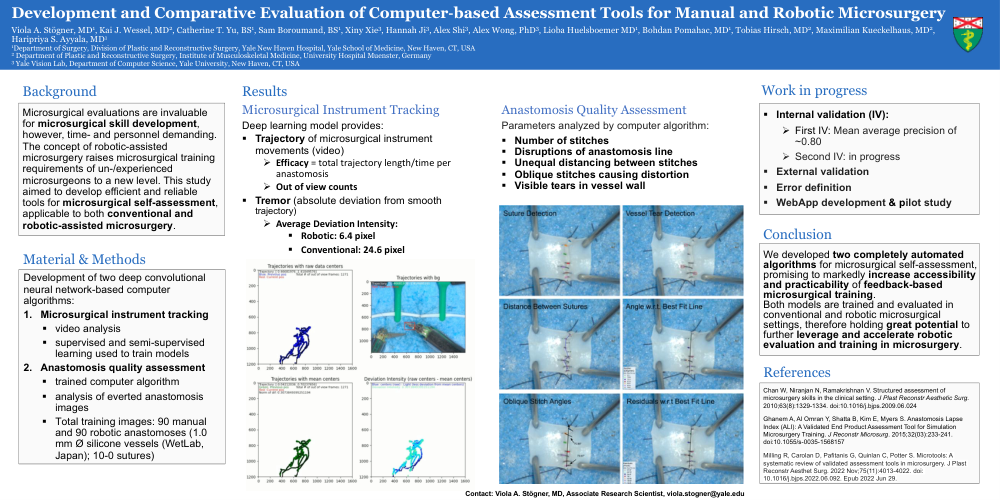
Microsurgical Instrument Tracking
Deep learning model provides:
Trajectory of microsurgical instrument
movements (video)
Efficacy = total trajectory length/time per
anastomosis
Out of view counts
Tremor (absolute deviation from smooth
trajectory)
Average Deviation Intensity:
Robotic: 6.4 pixel
Conventional: 24.6 pixel
Anastomosis Quality Assessment
Parameters analyzed by computer algorithm:
Number of stitches
Disruptions of anastomosis line
Unequal distancing between stitches
Oblique stitches causing distortion
Visible tears in vessel wall
Work in progress
Internal validation (IV):
First IV: Mean average precision of
~0.80
Second IV: in progress
External validation
Error definition
WebApp development & pilot study
Conclusion
We developed two completely automated
algorithms for microsurgical self-assessment,
promising to markedly increase accessibility
and practicability of feedback-based
microsurgical training.
Both models are trained and evaluated in
conventional and robotic microsurgical
settings, therefore holding great potential to
further leverage and accelerate robotic
evaluation and training in microsurgery.
References
Chan W, Niranjan N, Ramakrishnan V. Structured assessment of
microsurgery skills in the clinical setting. J Plast Reconstr Aesthetic Surg.
2010;63(8):1329-1334. doi:10.1016/j.bjps.2009.06.024
Ghanem A, Al Omran Y, Shatta B, Kim E, Myers S. Anastomosis Lapse
Index (ALI): A Validated End Product Assessment Tool for Simulation
Microsurgery Training. J Reconstr Microsurg. 2015;32(03):233-241.
doi:10.1055/s-0035-1568157
Milling R, Carolan D, Pafitanis G, Quinlan C, Potter S. Microtools: A
systematic review of validated assessment tools in microsurgery. J Plast
Reconstr Aesthet Surg. 2022 Nov;75(11):4013-4022. doi:
10.1016/j.bjps.2022.06.092. Epub 2022 Jun 29.
Contact: Viola A. Stögner, MD, Associate Research Scientist, viola.stogner@yale.edu