203 posters, 14 topics, 5 sessions, 817 authors, 256 institutions
ePostersLive by SciGen Technologies S.A. All rights reserved.
The AAPS 102nd Annual Meeting
May 18-21, 2024 | The Westin Copley Place, Boston, MA

P26
Botulinum Toxin Prevents Heterotopic Ossification In A Burn Mouse Model
Poster Presenter
Authors
Justin Davis, Carrie Harrison, Michelle Randle, Michael Neumeister, Nicole Sommer
Affiliations
Part of Topic
Innovations/Basic Science/Education & Practice Management
Heterotopic ossification (HO) is the formation of lamellar bone in soft tissue areas, usually involving large joints (hips, shoulders, elbows, knees). Therapeutic strategies for prevention of HO are still limited with varying degrees of success. Burn patients with higher TBSA are at higher risk1. Current therapies are lacking2.
Onabotulinum toxin A (BoNT-A is a well-established therapy for pain and spasticity that is also identified to act on anti-inflammatory pathways3.
Our aim was to identify therapeutic efficacy of BoNT-A in a burn model. This model was developed by Levi et al. developed HO in 100% of mice by inducing a 30% TBSA burn with a tenotomy of the achilles tendon
Hypothesis: BoNT-A inhibits the development of HO in a burn mouse model
Induce heterotopic ossification in an established burn mouse model – 30% TBSA burn with achilles tenotomy in mice under anesthesia4.
Two groups
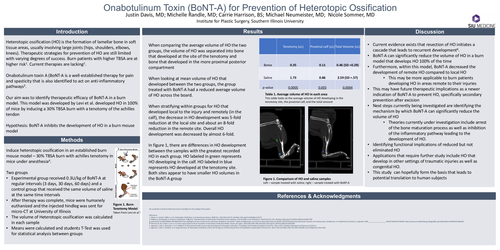
When comparing the average volume of HO the two groups, the volume of HO was separated into bone that developed at the site of the tenotomy and bone that developed in the more proximal posterior compartment
When looking at mean volume of HO that developed between the two groups, the group treated with BoNT-A had a reduced average volume of HO across the board.
When stratifying within groups for HO that developed local to the injury and remotely (in the calf), the decrease in HO development was 5-fold reduction at the local site and about an 8-fold reduction in the remote site. Overall HO development was decreased by almost 6-fold.
In figure 1, there are differences in HO development between the samples with the greatest recorded HO in each group. HO labeled in green represents HO developing in the calf. HO labeled in blue represents HO developed at the tenotomy site. Both sites appear to have smaller HO volumes in the BoNT-A group