203 posters, 14 topics, 5 sessions, 817 authors, 256 institutions
ePostersLive by SciGen Technologies S.A. All rights reserved.
The AAPS 102nd Annual Meeting
May 18-21, 2024 | The Westin Copley Place, Boston, MA

D151
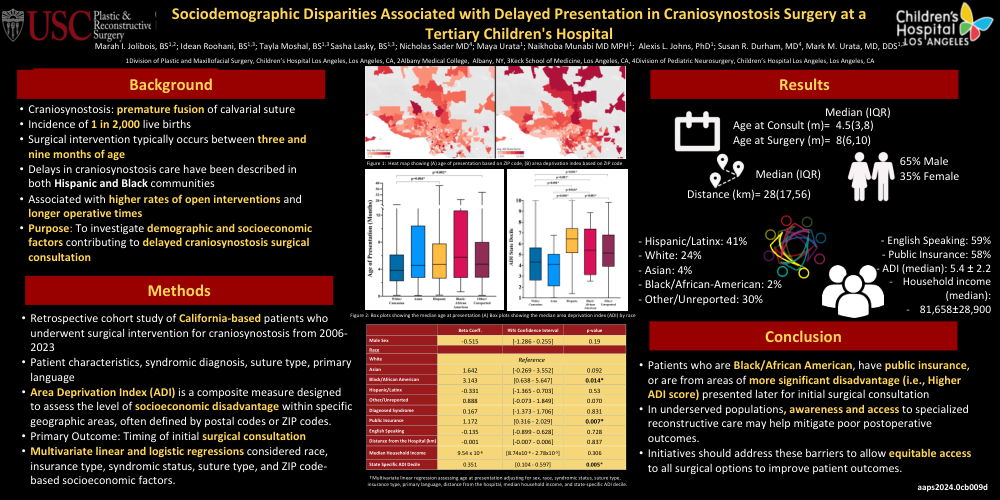
Socioeconomic Factors Associated With Delayed Presentation In Craniosynostosis Surgery At A Tertiary Children's Hospital
Poster Presenter
Authors
Affiliations
Part of Topic
Craniofacial/Peds
Socioeconomic Disparities Associated with Poor Postoperative Follow up in Craniosynostosis Surgery at a Tertiary Children's Hospital
Purpose: This study investigates socioeconomic disparities in postoperative care of patients with craniosynostosis at an urban tertiary children’s hospital.
Methods: A retrospective cohort study analyzed non-syndromic patients who underwent open surgical intervention for craniosynostosis between 2006 and 2023. Multivariate regressions considered demographic factors and the Area Deprivation Index (ADI) to estimate post-operative follow-up duration. ADI assesses socioeconomic status in zip codes on a decile scale (1 to 10) based on income, education, employment, and housing quality. Loss to follow-up was defined as follow-up duration less than 6 months.
Results: Among 644 patients, the average follow-up was 2.9±2.8 years (range: 0.1-17.0 years). 56.6% had public insurance and 60.7% were English-speaking. The median age at surgery was 8.0 [IQR: 5.8-10.4]. The mean ADI decile was 5.4±2.1. Linear regression revealed that younger age at surgery (β: -0.863, p=0.003), non-English speaking (β: 0.650, p=0.011), lower ADI decile (β: -0.049, p=0.019), and open surgical intervention (β: -1.897, p=0.005) were associated with longer postoperative follow-up. Patients undergoing surgery at an older age (OR: 2.256, p=0.030) or from higher ADI decile areas (OR: 1.061, p=0.046) were more likely to be lost to follow-up.
Conclusion: Patients who are older at the time of surgery and from areas of more significant disadvantage were more likely to have poor postoperative follow-up duration. Interventions should target these at-risk populations to mitigate disparities.