203 posters, 14 topics, 5 sessions, 817 authors, 256 institutions
ePostersLive by SciGen Technologies S.A. All rights reserved.
The AAPS 102nd Annual Meeting
May 18-21, 2024 | The Westin Copley Place, Boston, MA

D147
Cost Effectiveness Of Incisional Negative Pressure Wound Therapy In Penile Inversion Vaginoplasty
Poster Presenter
Authors
Affiliations
Part of Topic
Gender Affirmation
Cost effectiveness of incisional negative pressure wound therapy in penile inversion vaginoplasty
Abstract:
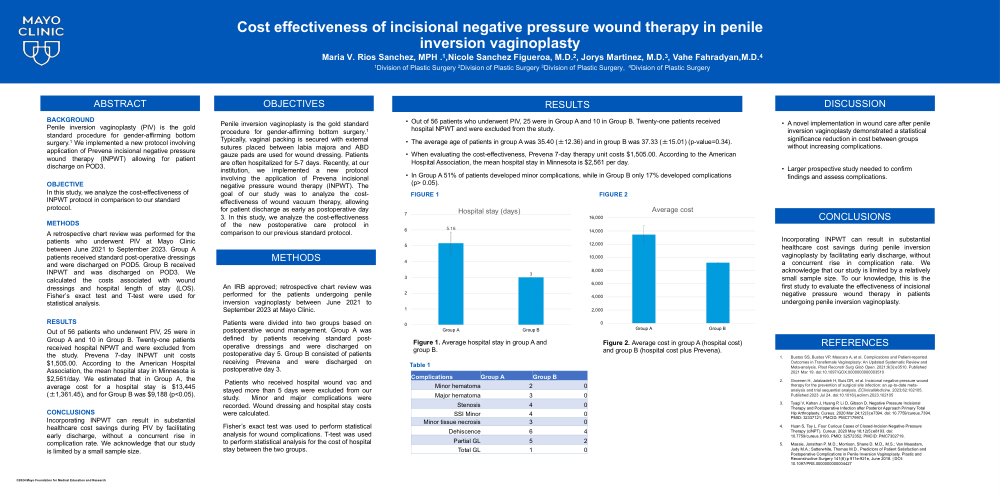
BACKGROUND: Penile inversion vaginoplasty (PIV) is the gold standard procedure for gender-affirming bottom surgery. We implemented a new protocol involving application of Prevena incisional negative pressure wound therapy (INPWT) allowing for patient discharge on POD3.
OBJECTIVE: In this study, we analyze the cost-effectiveness of INPWT protocol in comparison to our standard protocol.
METHODS: A retrospective chart review was performed for the patients who underwent PIV at Mayo Clinic between June 2021 to September 2023. Group A patients received standard post-operative dressings and were discharged on POD5. Group B received INPWT and was discharged on POD3. We calculated the costs associated with wound dressings and hospital length of stay (LOS). Fisher’s exact test and T-test were used for statistical analysis.
RESULTS: Out of 56 patients who underwent PIV, 25 were in Group A and 10 in Group B. Twenty-one patients received hospital NPWT and were excluded from the study. Prevena 7-day INPWT unit costs $1,505.00. According to the American Hospital Association, the mean hospital stay in Minnesota is $2,561/day. We estimated that in Group A, the average cost for a hospital stay is $13,445 (±1,361.45), and for Group B was $9,188 (p<0.05).
CONCLUSIONS:Incorporating INPWT can result in substantial healthcare cost savings during PIV by facilitating early discharge, without a concurrent rise in complication rate. We acknowledge that our study is limited by a small sample size.
OBJECTIVES:
Penile inversion vaginoplasty is the gold standard procedure for gender-affirming bottom surgery.Typically, vaginal packing is secured with external sutures placed between labia majora and ABD gauze pads are used for wound dressing. Patients are often hospitalized for 5-7 days. Recently, at our institution, we implemented a new protocol involving the application of Prevena incisional negative pressure wound therapy (INPWT). The goal of our study was to analyze the cost-effectiveness of wound vacuum therapy, allowing for patient discharge as early as postoperative day 3. In this study, we analyze the cost-effectiveness of the new postoperative care protocol in comparison to our previous standard protocol.
METHODS:
An IRB approved; retrospective chart review was performed for the patients undergoing penile inversion vaginoplasty between June 2021 to September 2023 at Mayo Clinic.
Patients were divided into two groups based on postoperative wound management. Group A was defined by patients receiving standard post-operative dressings and were discharged on postoperative day 5. Group B consisted of patients receiving Prevena and were discharged on postoperative day 3.
Patients who received hospital wound vac and stayed more than 5 days were excluded from our study. Minor and major complications were recorded. Wound dressing and hospital stay costs were calculated.
Fisher’s exact test was used to perform statistical analysis for wound complications. T-test was used to perform statistical analysis for the cost of hospital stay between the two groups.
RESULTS:
Incorporating INPWT can result in substantial healthcare cost savings during penile inversion vaginoplasty by facilitating early discharge, without a concurrent rise in complication rate. We acknowledge that our study is limited by a relatively small sample size. To our knowledge, this is the first study to evaluate the effectiveness of incisional negative pressure wound therapy in patients undergoing penile inversion vaginoplasty.
REFERENCES: