203 posters, 14 topics, 5 sessions, 817 authors, 256 institutions
ePostersLive by SciGen Technologies S.A. All rights reserved.
The AAPS 102nd Annual Meeting
May 18-21, 2024 | The Westin Copley Place, Boston, MA

D135
Price Transparency For Gender-Affirming Surgical Procedures In Large U.S. Hospitals
Poster Presenter
Authors
Amitai Miller, James Fanning, Daniela Lee, Avery Allen, Manraj Kaur, Geraldine Serwald, Kavitha Ranganathan
Affiliations
Harvard Medical School, Division of Plastic and Reconstructive Surgery, Department of Surgery, Beth Israel Deaconess Medical Center, Stern College for Women, Yeshiva University,, Patient-Reported Outcomes, Value and Experience (PROVE) Center, Department of Surgery, Brigham and Women's Hospital, Division of Plastic and Reconstructive Surgery, Brigham and Women’s Hospital
Part of Topic
Gender Affirmation
Price Transparency for Gender-Affirming Surgical Procedures in Large U.S. Hospitals
Objectives:
Hospitals must publish prices for at least 300 shoppable services, often accomplished via a price estimator tool. Price transparency increases informed patient decision-making and may lower costs through market competition. Transgender and gender-diverse (TGD) people face many barriers when seeking gender-affirming surgery (GAS), with cost concerns being prominent impediments to care.
This study examines GAS information availability on U.S. hospital websites and assesses their GAS price transparency efforts.
Methods:
The 100 largest U.S. hospitals by inpatient bed volume (excluding specialized facilities) were queried for GAS information in October 2023. We examined 66 common gender-affirming craniofacial, chest, and genital procedures via Current Procedural Terminology codes (CPT) using hospital price estimator tools. Information on states’ bans on TGD-related care insurance exclusions was gathered from the Movement Advancement Project. Hospitals’ states, ownership type, and Medicaid revenue were gathered from the Centers for Medicare and Medicaid Services. Chi-squared tests were used to explore relationships between the variables.
Results:
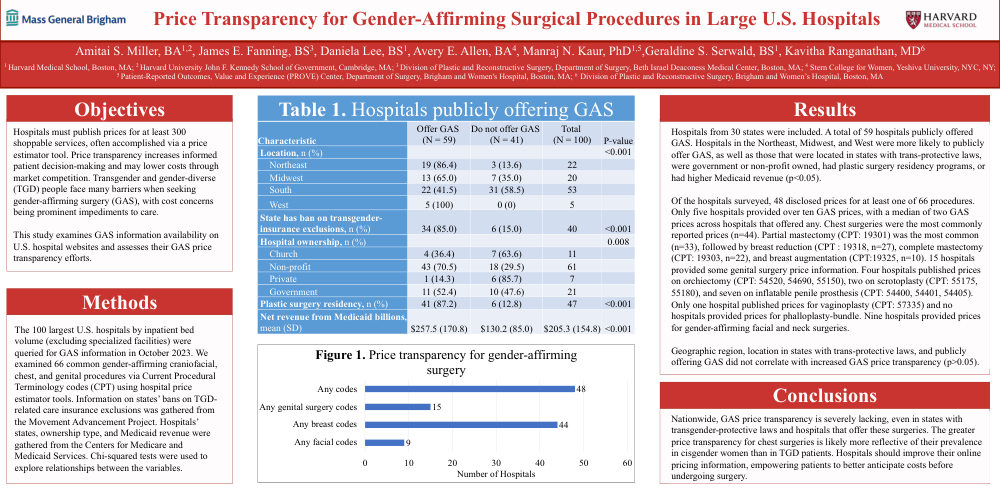
Hospitals from 30 states were included. A total of 59 hospitals publicly offered GAS. Hospitals in the Northeast, Midwest, and West were more likely to publicly offer GAS, as well as those that were located in states with trans-protective laws, were government or non-profit owned, had plastic surgery residency programs, or had higher Medicaid revenue (p<0.05).
Of the hospitals surveyed, 48 disclosed prices for at least one of 66 procedures. Only five hospitals provided over ten GAS prices, with a median of two GAS prices across hospitals that offered any. Chest surgeries were the most commonly reported prices (n=44). Partial mastectomy (CPT: 19301) was the most common (n=33), followed by breast reduction (CPT : 19318, n=27), complete mastectomy (CPT: 19303, n=22), and breast augmentation (CPT:19325, n=10). 15 hospitals provided some genital surgery price information. Four hospitals published prices on orchiectomy (CPT: 54520, 54690, 55150), two on scrotoplasty (CPT: 55175, 55180), and seven on inflatable penile prosthesis (CPT: 54400, 54401, 54405). Only one hospital published prices for vaginoplasty (CPT: 57335) and no hospitals provided prices for phalloplasty-bundle. Nine hospitals provided prices for gender-affirming facial and neck surgeries.
Geographic region, location in states with trans-protective laws, and publicly offering GAS did not correlate with increased GAS pricetransparency (p>0.05).
Conclusions:
Nationwide, GAS price transparency is severely lacking, even in states with transgender-protective laws and hospitals that offer these surgeries. The greater price transparency for chest surgeries is likely more reflective of their prevalence in cisgender women than in TGD patients. Hospitals should improve their online pricing information, empowering patients to better anticipate costs before undergoing surgery.