203 posters, 14 topics, 5 sessions, 817 authors, 256 institutions
ePostersLive by SciGen Technologies S.A. All rights reserved.
The AAPS 102nd Annual Meeting
May 18-21, 2024 | The Westin Copley Place, Boston, MA

D146
Moving To 3D: Post-Surgical Cephalometric Changes And Surgical Planning Accuracy Using Volumetric Analysis In Facial Feminization Surgery
Poster Presenter
Authors
Sophia Hu, Julie Lawrence, Calvin Schuster, Ali Gunduz Sarioglu, Erik Reiche, Siti Rahmayanti, Michael Parisi, Cynthia Yusuf, Robin Yang, Devin Coon
Affiliations
Division of Plastic Surgery, Brigham & Women's Hospital and Harvard Medical School, Department of Anthropology, Harvard University, Division of Plastic Surgery, Johns Hopkins University School of Medicine
Part of Topic
Gender Affirmation
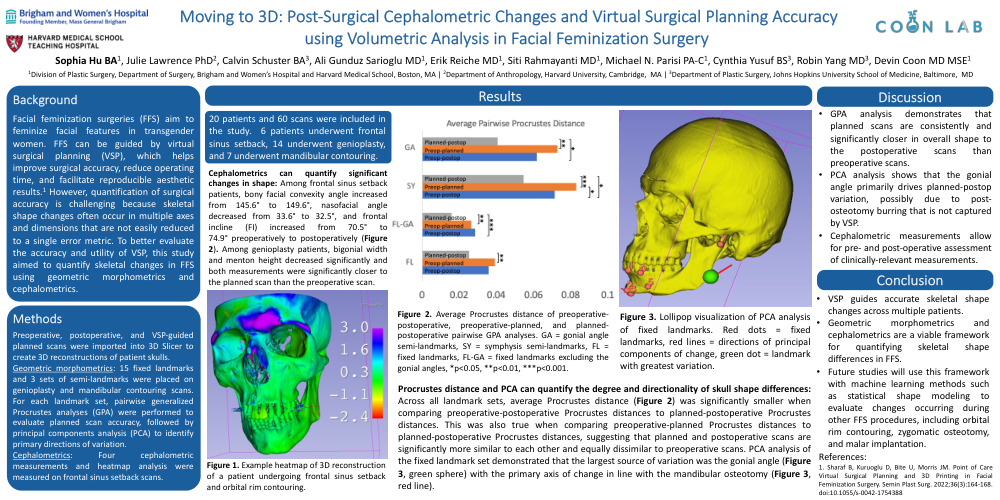
Moving to 3D: Post-Surgical Cephalometric Changes and Virtual Surgical Planning Accuracy using Volumetric Analysis in Facial Feminization Surgery Sophia Hu BA1, Julie Lawrence PhD2, Calvin Schuster BA3, Ali Gunduz Sarioglu MD1, Erik Reiche MD1, Siti Rahmayanti MD1, Michael N. Parisi PA-C1, Cynthia Yusuf BS3, Robin Yang MD3, Devin Coon MD MSE1 1Division of Plastic Surgery, Department of Surgery, Brigham and Women’s Hospital and Harvard Medical School, Boston, MA | 2Department of Anthropology, Harvard University, Cambridge, MA | 3Department of Plastic Surgery, Johns Hopkins University School of Medicine, Baltimore, MD Background Methods Preoperative, postoperative, and VSP-guided planned scans were imported into 3D Slicer to create 3D reconstructions of patient skulls. Geometric morphometrics: 15 fixed landmarks and 3 sets of semi-landmarks were placed on genioplasty and mandibular contouring scans. For each landmark set, pairwise generalized Procrustes analyses (GPA) were performed to evaluate planned scan accuracy, followed by principal components analysis (PCA) to identify primary directions of variation. Cephalometrics: Four cephalometric measurements and heatmap analysis were measured on frontal sinus setback scans. 20 patients and 60 scans were included in the study. 6 patients underwent frontal sinus setback, 14 underwent genioplasty, and 7 underwent mandibular contouring. Procrustes distance and PCA can quantify the degree and directionality of skull shape differences: Across all landmark sets, average Procrustes distance (Figure 2) was significantly smaller when comparing preoperative-postoperative Procrustes distances to planned-postoperative Procrustes distances. This was also true when comparing preoperative-planned Procrustes distances to planned-postoperative Procrustes distances, suggesting that planned and postoperative scans are significantly more similar to each other and equally dissimilar to preoperative scans. PCA analysis of the fixed landmark set demonstrated that the largest source of variation was the gonial angle (Figure 3, green sphere) with the primary axis of change in line with the mandibular osteotomy (Figure 3, red line). Figure 2. Average Procrustes distance of preoperativepostoperative, preoperative-planned, and plannedpostoperative pairwise GPA analyses. GA = gonial angle semi-landmarks, SY = symphysis semi-landmarks, FL = fixed landmarks, FL-GA = fixed landmarks excluding the gonial angles, *p<0.05, **p<0.01, ***p<0.001. Figure 1. Example heatmap of 3D reconstruction of a patient undergoing frontal sinus setback and orbital rim contouring. Figure 3. Lollipop visualization of PCA analysis of fixed landmarks. Red dots = fixed landmarks, red lines = directions of principal components of change, green dot = landmark with greatest variation. Results Facial feminization surgeries (FFS) aim to feminize facial features in transgender women. FFS can be guided by virtual surgical planning (VSP), which helps improve surgical accuracy, reduce operating time, and facilitate reproducible aesthetic results. 1 However, quantification of surgical accuracy is challenging because skeletal shape changes often occur in multiple axes and dimensions that are not easily reduced to a single error metric. To better evaluate the accuracy and utility of VSP, this study aimed to quantify skeletal changes in FFS using geometric morphometrics and cephalometrics. Cephalometrics can quantify significant changes in shape: Among frontal sinus setback patients, bony facial convexity angle increased from 145.6° to 149.6° , nasofacial angle decreased from 33.6° to 32.5° , and frontal incline (FI) increased from 70.5° to 74.9° preoperatively to postoperatively (Figure 2). Among genioplasty patients, bigonial width and menton height decreased significantly and both measurements were significantly closer to the planned scan than the preoperative scan. Discussion • GPA analysis demonstrates that planned scans are consistently and significantly closer in overall shape to the postoperative scans than preoperative scans. • PCA analysis shows that the gonial angle primarily drives planned-postop variation, possibly due to postosteotomy burring that is not captured by VSP. • Cephalometric measurements allow for pre- and post-operative assessment of clinically-relevant measurements. Conclusion • VSP guides accurate skeletal shape changes across multiple patients. • Geometric morphometrics and cephalometrics are a viable framework for quantifying skeletal shape differences in FFS. • Future studies will use this framework with machine learning methods such as statistical shape modeling to evaluate changes occurring during other FFS procedures, including orbital rim contouring, zygomatic osteotomy, and malar implantation. References: 1. Sharaf B, Kuruoglu D, Bite U, Morris JM. Point of Care Virtual Surgical Planning and 3D Printing in Facial Feminization Surgery. Semin Plast Surg. 2022;36(3):164-168. doi:10.1055/s-0042-1754388