203 posters, 14 topics, 5 sessions, 817 authors, 256 institutions
ePostersLive by SciGen Technologies S.A. All rights reserved.
The AAPS 102nd Annual Meeting
May 18-21, 2024 | The Westin Copley Place, Boston, MA

D113
Use Of Buccal Fat Pad Flaps In Primary Palatoplasty Does Not Increase Risk For Obstructive Sleep Apnea
Part of Topic
Craniofacial/Peds
PURPOSE:
•Congenital cleft palate is associated with increased risk for the development of velopharyngeal insufficiency (VPI) and obstructive sleep apnea (OSA). Optimizing palatal growth and improving dynamic function of the levator sling may mitigate the progression of these disorders in patients with cleft palate. The use of the buccal fat pad flap (BFPF) in primary palatoplasty was recently shown to reduce incidence of VPI, but its associated impact on development of OSA has yet to be studied.
•Utilization of BFPFs improves the growth and physiologic function of the palate by providing vascularized soft tissue, thereby mitigating scarring, improving maxillary growth, preventing readherence of the levator muscles, and enabling healthy function of the levator sling mechanism. We hypothesize that BFPF use leads to gain in palatal function and therefore confers no greater risk for OSA than palatoplasty alone.
•BFPFs may be placed in several configurations. Anterior placement over the lateral relaxing incisions provides vascular soft tissue over denuded maxillary bone. Posterior placement in the interpositional void between the oral and nasal linings provides bulk to the soft palate and creates steric hindrance to preserve the anatomic position of the levator muscle after repair. Both locations may be accomplished simultaneously by harvesting bilateral BFPFs and using one BFPF for each configuration.
METHODS:
•A single center, retrospective chart review identified patients that underwent cleft palatoplasty with or without BFPF from 1995-2015. Data collected included age at time of surgery, Veau cleft classification, details of surgery, history of adenotonsillectomy (T/A), and length of follow-up. Patients with symptoms of OSA were evaluated by a pediatric sleep medicine specialist.
•The primary outcome measure was development of OSA, defined as prescription of continuous positive airway pressure (CPAP) therapy by a sleep medicine specialist. Secondary outcomes included rate of resolution of OSA symptoms following adenotonsillectomy, and development of OSA after speech surgery and fistula revision.
RESULTS:
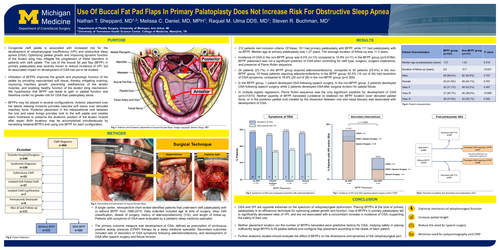
•212 patients met inclusion criteria. Of these, 101 had primary palatoplasty with BFPF, while 111 had palatoplasty with no BFPF. Median age at primary palatoplasty was 1.27 years. The average duration of follow-up was 11.3 years.
•Incidence of OSA in the non-BFPF group was 9.0% (n=10) compared to 10.9% (n=11) in the BFPF group (p=0.6784). BFPF placement was not a significant predictor of OSA when controlling for cleft type, surgeon, surgeon experience, and presence of Pierre Robin sequence.
•24 patients (23.7%) in the BFPF group required adenotonsillectomy, compared to 30 patients (23.4%) in the non-BFPF group. Of those patients requiring adenotonsillectomy in the BFPF group, 62.5% (15 out of 24) had resolution of OSA symptoms, compared to 76.9% (20 out of 26) in the non-BFPF group (p=0.358).
•In the BFPF group, 1 patient developed OSA following speech surgery. In the non-BFPF group, 5 patients developed OSA following speech surgery, while 2 patients developed OSA after surgical revision for palatal fistula.
•In multiple logistic regression, Pierre Robin sequence was the only significant predictor for development of OSA (p=0.01473). Neither quantity of BFPF harvested (unilateral vs bilateral) nor BFPF location (over denuded palatal bone, or in the posterior palatal void created by the dissection between oral and nasal tissues) was associated with development of OSA.
CONCLUSION:
•OSA and VPI are opposite extremes on the spectrum of velopharyngeal dysfunction. Placing BFPFs at the time of primary palatoplasty is an efficacious technique for optimizing palatal growth and function. Use of BFPFs in primary palatoplasty led to significantly decreased rates of VPI, and are not associated with a concomitant increase in incidence of OSA, supporting the safety of their use.
•Neither placement location nor the number of BFPFs harvested were predictive factors for OSA, implying safety in placing sufficiently large BFPFs to fill palatal defects and configure flap placement according to the needs of each patient.
•Further anatomic studies should evaluate the effect of BFPFs on the dimensions and dynamics of the velopharyngeal port.